web analytics

Life as we know it

You are currently browsing the archive for the Life as we know it category.

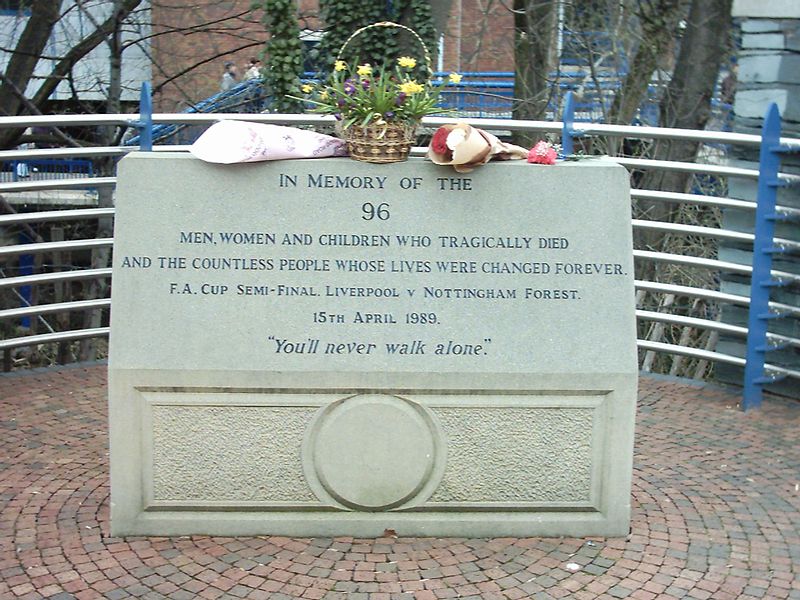
Image by Superbfc at the English language WikipediaYou might have thought that my recent post regarding the outcome of the second inquest into the causes of the deaths of the ninety six victims of the 1989 Hillsborough disaster would be my last word on the subject. I suspect, however, that there will be yet more to come as the saga continues to unfold over the years.

This truth was brought home yet again last night in harrowing fashion as I watched Daniel Gordon’s two hour documentary – ‘Hillsborough‘ – made for the BBC and ESPN. The first version of this brilliantly judged work was completed nearly two years ago and shown in the US and – subsequently – in New Zealand. It could not at that time be shown in the UK for legal reasons; for fear that it might prejudice the outcome of the second inquest which had then just begun.

The film has now been extended in the light of the outcome of that inquiry and can now finally be seen in the UK and elsewhere. Should you yet feel uncertain as to the import of these recent events – or should you even perchance still harbour some misconceptions as to the truth of what really happened on that dreadful day and throughout the intervening twenty seven years – I urge you to take the time to watch this chilling memorial to the suffering of the families whose loved ones did not return home from that intended day of celebration.

Though I have been reading about the tragedy since the day that it happened, even so I learned things from this film that I had not previously known. This merely demonstrates anew just how much the authorities tried to keep hidden over the past two decades and more.

For example, I did not know that there had been another not dissimilar crowd control problem at an FA Cup semi-final at Hillsborough – some eight years earlier. On that occasion the crowd at the Leppings Lane end had been allowed to spill out of the stands onto the border of the pitch itself to avoid the crush. When – during the post mortem to that event – it was suggested that there had been a lucky escape and that modifications might be required to prevent future injuries or deaths, the ground’s owners and engineers dismissed the suggestion and did nothing.

Indeed – in the intervening years matters were made very much worse as a result of the FA’s misguided attempt to combat the hooliganism which seemed endemic to the game during the 1980s. The standing room terraces at the Leppings Lane end of the ground were turned into pens by the construction around them of fences of spiked iron railings. When lightening did indeed strike a second time the supporters were unable either to escape onto the pitch or sideways along the terracing as had previously been possible.

In another unfortunate circumstance the vastly experienced police superintendent, Brian Mole, who should have been in charge of the crowd control operation on the day of the disaster, was moved to another district a couple of weeks prior to the event. This followed a ‘hazing’ incident some months before in which a young police constable was one night subjected to a mock abduction by masked gunmen posing as armed robbers but who were in fact colleagues from the constabulary. Those concerned were disciplined firmly and Mole – though having no involvement himself – was moved.

His place was taken – at two weeks’ notice – by a man who not only had little experience of supervising such major events but also clearly had little understanding of football or of the habits and motivations of its followers. David Duckenfield was responsible for the two key actions that shaped the tragedy that followed and the appalling campaign that succeeded it.

First, he took the decision – when the crush of Liverpool supporters trying to get through the totally inadequate number of turnstiles at the Leppings Lane end looked to be getting out of hand – to open one of the exit gates to allow a large body of fans through to relieve the pressure outside. This was done without first having either sealed off the immediate entrance to the two already packed pens which was directly in front of the exit gate, or of ensuring that there were an adequate number of stewards or police inside the ground to direct fans to the still mostly empty pens to either side.

Then – as the inevitable tragedy was still being played out immediately beneath the windows of the control box in which he was located – Duckenfield lied to Graham Kelly (the FA representative at the ground) telling him that drunken ticket-less Liverpool supporters had broken down the very exit gate that he had himself ordered to be opened. Kelly naturally believed what he was told by the senior police official present and wasted no time passing the information on TV commentators and journalists. Thus was born the false myth that the supporters were to blame for the deaths of the ninety six, which was then seized upon by those in charge of all of the authorities concerned as a means of covering up the truth as to the multiple liabilities for the fatalities.

Daniel Gordon’s documentary is not an easy watch but it is an essential one if we are to fully comprehend this recent period in our history, for it has implications far wider simply than those for game of football or for this one appalling, tragic, but completely avoidable incident.

 

Tags: , , , ,

justice-collectiveThis day – twenty seven years after the event – the second inquest into the Hillsborough disaster – having been convened after the findings of the original inquest were quashed following the report of an independent panel four years ago – finally declared that the ninety six Liverpool Football Club supporters who lost their lives on that terrible day were killed unlawfully.

Though this is far from the end of the process – the Crown Prosecution Service may now decide to commence criminal proceedings against those deemed to have been culpable – it is to be hoped that the relatives and friends of those whose lives were lost can now finally grieve them properly and that – for their sakes – a line can be drawn. The shameful treatment to which they and others were subjected throughout this outrageous miscarriage of justice must, however, never be forgotten.

It is now clear that terrible mistakes and lapses of judgement were made both on the day and beforehand by those charged with ensuring the safety of the fans attending the FA Cup semi-final between Liverpool and Nottingham Forest that was to be played at Sheffield Wednesday’s Hillsborough stadium.

Terrible as were the events of the day itself, however, what followed was in some ways even more awful. The twenty five year campaign of obfuscation and misinformation that was waged by executives of all of the key agencies – the aim of which was to draw attention away from those actually responsible for the disaster, in large part by pushing the blame on to the supporters themselves – should of itself in any just world give rise to criminal proceedings.

That these attempts at evasion found support through the active or passive collusion of other forces of the ‘establishment’ leaves a stain which may not be removed in our lifetimes. The then Prime Minister Margaret Thatcher’s press secretary – Bernard Ingham – wrote a letter to one of the Hillsborough campaigners in the mid 90s blaming the tragedy on “tanked up yobs“, a slander for which he still refuses to apologise in spite of the new inquest’s complete exoneration of the supporters’ behaviour.

The divisions in English society that have been increasingly actively fostered from the 1980s onward must surely in part be to blame for such reprehensible attitudes. As long as a monied and powerful elite – puffed up with its own sense of entitlement and residing primarily in the south east of the country – determinedly sets itself apart from humbler mortals throughout the rest of the land, the notion that the latter belong to some lesser order that can be traduced as desired will – though unspoken – continue to prevail.

It seems to me inevitable that – unless the growing inequality that blights modern society can be reversed – such travesties on the part of those in authority are likely to continue.

Tags: , , , ,

Photo by Andy Dawson Reid“Chinstrap: Here’s to the old country, sir!
Bloodnok: What old country?
Chinstrap: Any old country.”

The Goon Show, ‘Shifting Sands’

It is fairly widely acknowledged that – for the expat Brit looking for somewhere not too ‘foreign’ in which to establish his or her habitat – Vancouver Island, and Victoria in particular, pretty much tops the bill.

Many things about life on the southern tip of Vancouver Island will seem familiar to those from England – from the red double decker buses, the unexpected fondness for cricket, rugby and rowing, the love of messing about in boats, the discovery that hoards of other Brits have already made the journey – right down to the fact that the locals very nearly speak the same language as do we in the old country!

The fact that the standard of living is so high (whilst the cost of petrol (gas) is so low) and the discovery that the climate is way better than that in the south of England make living here a no-brainer. For those who prefer a relaxed, casual we(s)t-coast lifestyle, with perhaps just a slight tendency to left of centre politics… well – check! check! Plus – the familiar comfort of living on an island… Plus – being within sight of the sea and the mountains just about everywhere… Plus – just how beautiful it all is!

Little surprise though that one gets the occasional reminder of the old country herself. Some such – however – come as more of a surprise than others. Herewith a few recent examples.

I have in my meagre wardrobe a rather swish replica Great Britain polo shirt, of which I am inordinately fond. It has on the left sleeve at suitably subtle Union Jack emblem. Wearing this out and about seems not infrequently to inspire those of a certain background to approach and engage me in conversation. For example – just the other day in ‘Thrifty’s‘ – our local supermarket:

He:   “Bet you wish you were back there now?

I:      “Oh – well I only got here last summer – and I love it!

He:   “Ah!” – a pause – “What’s it like there now – with all the immigration?

I:      “Um – well, around London it hasn’t really changed that much since I was a youngster. It always was a very multi-cultural city.

He:   “I read about it the Daily Express!

I suggested as gently as possible that a British tabloid rag – particularly without the sense of balance that might have come with actually living in the place concerned – was possibly not the most reliable source of what might delicately be called ‘the truth!’. I’m not sure he was convinced. He was – he told me proudly – a Welshman! I thought it best not to point out that the main source of immigration in his part of the world was probably the English purchasing holiday cottages in sleepy Welsh villages.

Photo by Andy Dawson ReidBut a short step along the road from ‘Thrifty’s‘ is one of Sidney’s many bookshops – in this case a secondhand and antique bookseller. I paid them a visit following my grocery shop to see if they had a copy of a particular marine atlas for which I have been searching.

They did not!

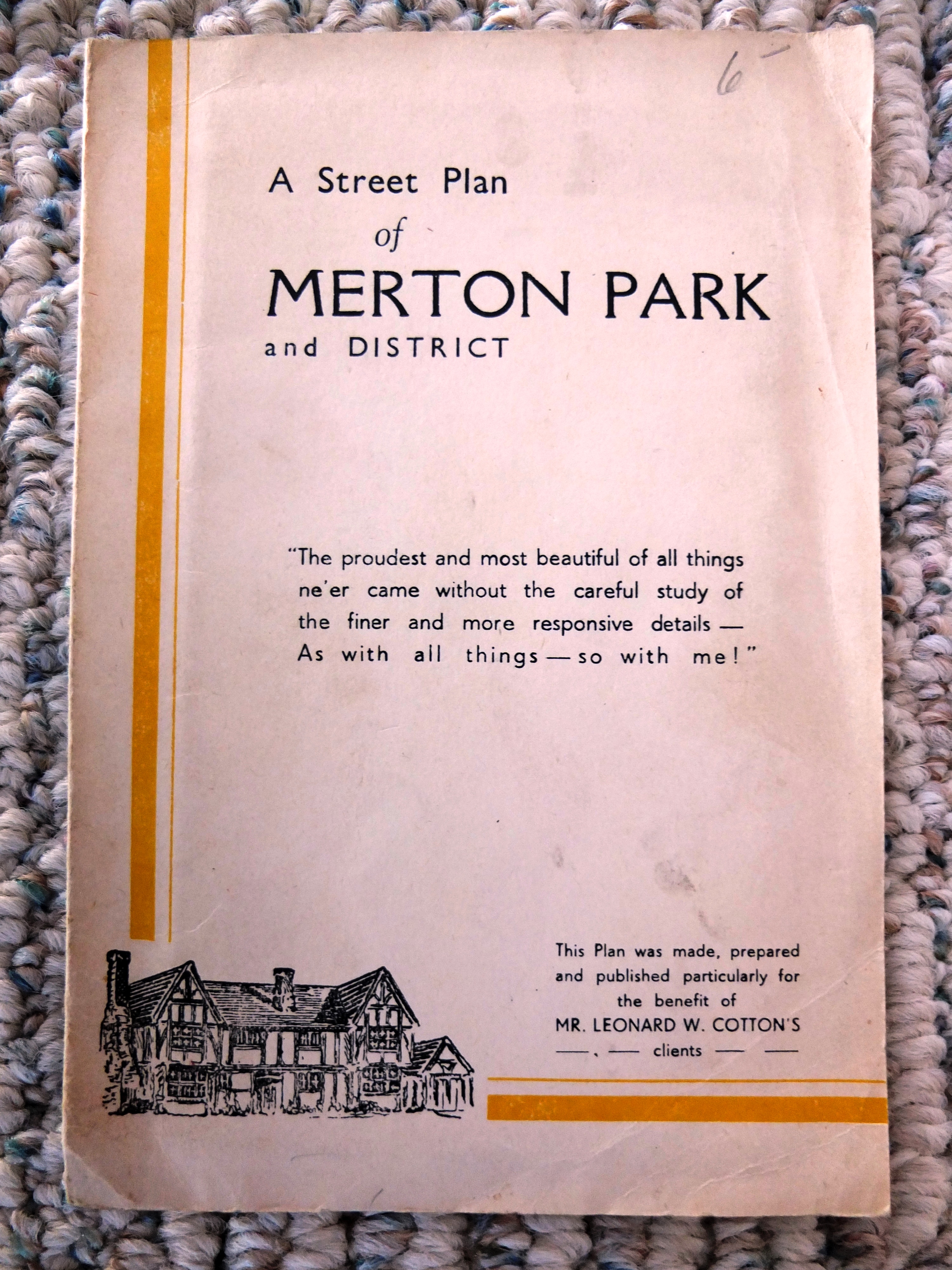
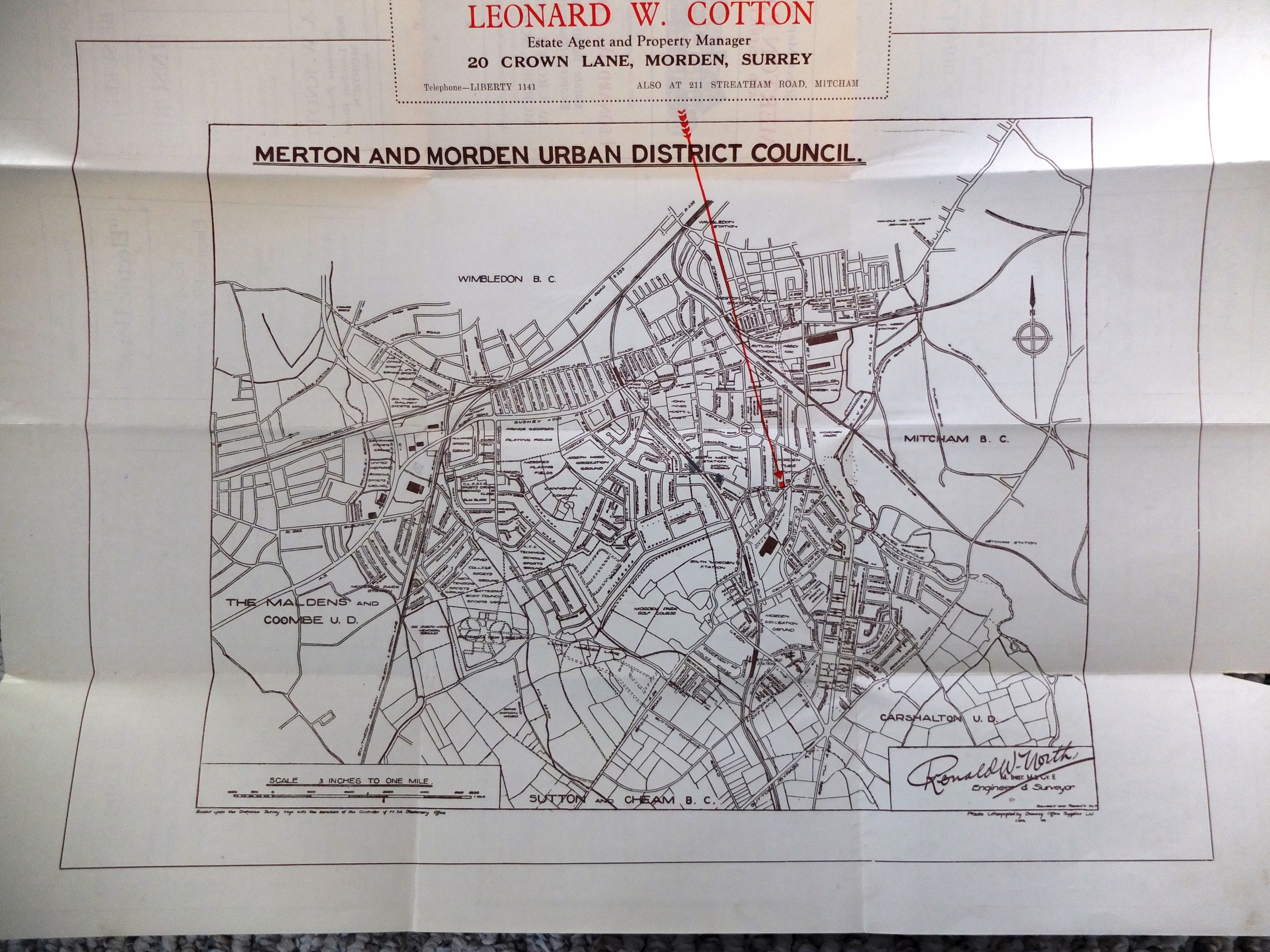
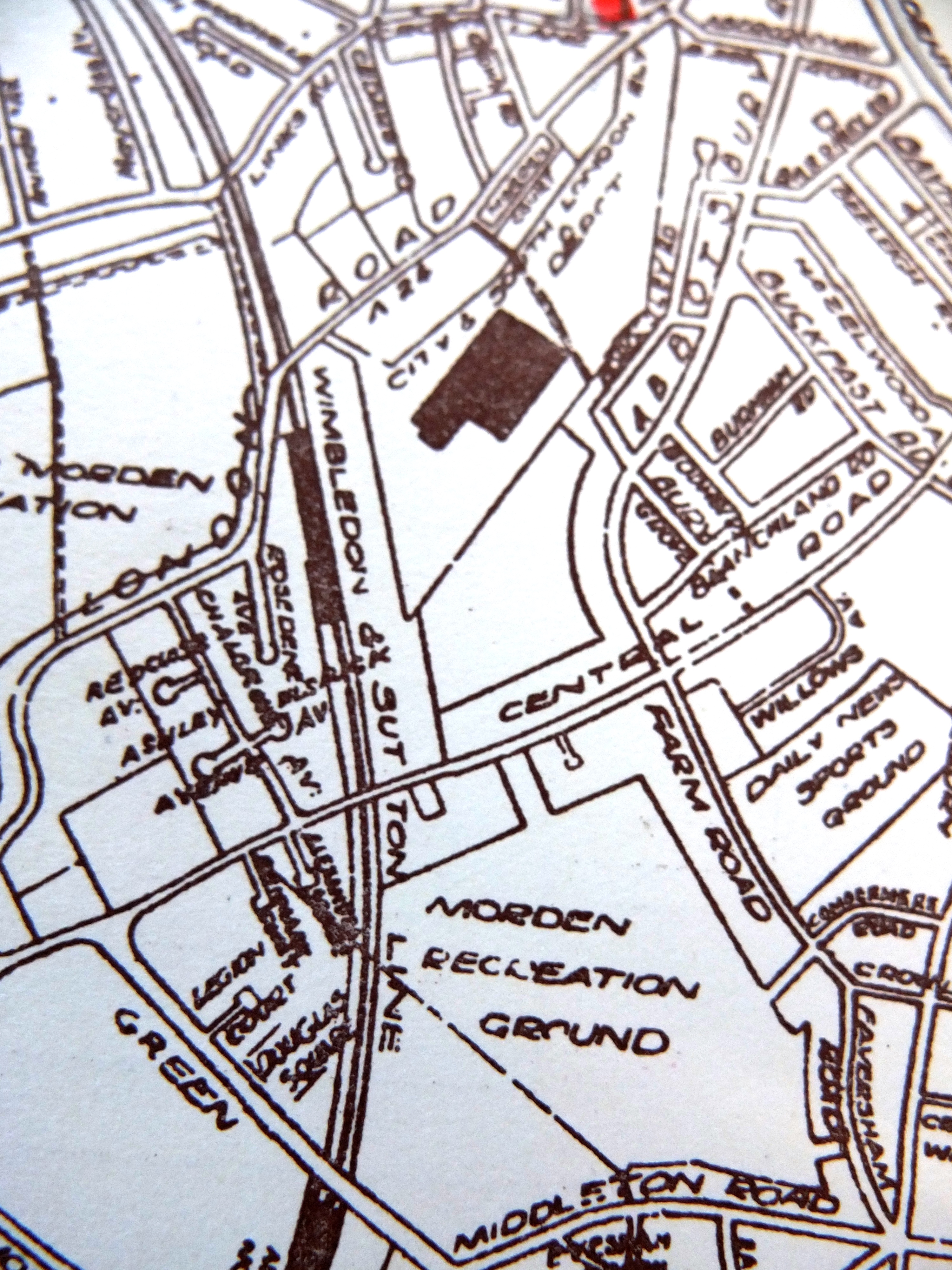
I did, however, discover – taped in a polythene bag to the outside end of one of their bookcases – this estate agent’s (realtor’s) street plan of the Merton Park area to the south of London. The map is not dated but – from various features contained thereon – I can deduce that it was printed sometime in the early 1930s. At that time Merton Park and Morden (Merton’s close neighbour) were outside London in the English county of Surrey. These days the area is some twenty miles inside the Greater London boundary.

This was certainly an odd item to find some five thousand miles away on the far side of the world – but why did it interest me enough that I felt at once moved to purchase it?

It shows the street on which I was born!

Photo by Andy Dawson Reid

Tags: , ,

imageIn the early days of these scribblings I ‘penned’ a piece on the mysteries of creativity. That I feel moved now to add something to that disquisition can only be seen as an indication of the continuing surprise and delight that the whole business affords me – as certainly must also be the case for anyone else who ventures into the realms of self-expression.

Thomas Edison famously declared that genius was “One percent inspiration, ninety nine percent perspiration” (though other accounts give the figures as ‘ten’ and ‘ninety’ percent respectively. I don’t suppose that it really matters much either way – the point is made!). The same could certainly be said of practically all forms of creativity.

A prominent playwright – sadly I forget which – opined that the art of writing might more properly be called ‘re-writing’. His point being, of course, that writing a play (or anything else for that matter) not only comprises the two basic elements (the inspirational phase in which ideas and musings are recorded as quickly as possible as they occur to the author/composer, and – following a suitable period of reflection – an extensive process of editing) but also – in order that the the piece might be rendered ready for ‘public’ appraisal – it will inevitably have gone through a considerable number of re-writes before anyone else is allowed to see it.

Much of this process is – of course – ‘craft’, and relatively few are sufficiently competent at it to be able to make a living therefrom. Inspiration is something else and the mysteries thereof are still not readily understood – especially by me!

The story of Paul McCartney waking one morning with the score for ‘Yesterday’ fully formed in his head might be thought apocryphal, were it not that it is attested to by the great man himself. Anyone who has experienced anything remotely similar will identify with McCartney as he – believing at first that he must have heard the song elsewhere – quizzed friends and colleagues as to what it might be.

My own recent experience was considerably more prosaic.

A few posts back I referred to a brief wave of melancholy that passed over me during the first few days of March, brought on by recollections of my Mother whose birthday would have been around that time. I felt moved to compose a song in an appropriately thoughtful vein. My Mother had slipped into dementia in the last year of her life and I felt the need to try to capture something of that elegiac mood. Sitting at the keyboard I rapidly found an interesting harmonic progression around which I started to experiment. An image came to mind – of a bonfire on a dark night. The dying embers swirling up into the night sky before fading into the blackness seemed to offer a possible metaphor for a mind slowly floating apart and a personality fading away.

It was at this point – however – that the subconscious part of the imagination took over. The more I worked the theme the more it seemed determined to evolve into something else entirely. I ended up with something that sounded more celebratory than melancholy. There is only one thing to do in such circumstances – and that is to give the imagination its head. Within a couple of days I had recorded all of the components of what had turned out to be a rather uplifting piece. Further – the image of the fire in the darkness had remained but had itself evolved and become a beacon fire lit on a hilltop to celebrate the end of winter. The song had changed from a lament over something lost to a celebration of something gained – in this case my recent recognition of my significance here.

That such a creative act is possible – and in such a brief period of time (a song can take me months to complete!) – is to me a thing of wonder and amazement and I am massively grateful that such occurrences still take place. Those of a spiritual or metaphysical bent might muse that perhaps this was a gift to me from my Mother. Maybe so.

I am content simply to enjoy the mystery.

Tags: , ,

Image from PixabayThose gentle readers who have become accustomed to my – er – ‘style’ will doubtless already have gathered that the recent ‘nostalgic’ post concerning my youth theatre past was an essential part of the extended meditation on the subjects of home-sickness and significance with which I have of late been grappling. Big topics both!

You will probably also have figured – had you been of a mind to plough through those tracts – that the object of my cogitation whilst beset by that malaise in the run up to Christmas was indeed that very period in my life. For reasons that I could not immediately determine I found myself exhaustively replaying memories of the several decades and more from the early 70s to the mid 90s during which I helped to run a local authority youth theatre in the south east of England.

When I was but a young man I desperately wished to become a professional musician. Others with whom I played did achieve this – some to great success – but it became clear pretty early on that I was not sufficiently gifted to belong amongst their number. When I got involved with the youth theatre and began to write musicals for them I took that very seriously as well, hoping – with my co-writers – that we might at some point merit a professional performance of one of these works. That didn’t happen either. Now that I write plays – having run out of partners with whom to write musicals – I still harbour hopes that I might eventually get one published. The odds are long, I know – but this is a dream that I still cherish.

Through my great fortune in having being given the chance to work with the drama departments of two of the UK’s greatest schools – each of which has more than played its part in the generation of the new wave of brilliantly talented young thespists – I have slowly come to the realisation that my true role lies in the encouragement and promotion of a passion for creativity in young people.

I am not qualified to teach in BC and I would not in any case wish to go back to work in education. It became very clear to me during my pre-Christmas funk, however, that my true role is in doing almost exactly that which I was doing more than two decades previously. I should be involved in youth theatre. I determined there and then that, should I not be able to find a suitable venture with which to become involved, I would just have to start something myself.

Things have been set in motion, about which much more anon. They best thing – from my point of view – is that I am once again beginning to get a sense of what I am here for…

…and that is a very good thing!

Tags: , , ,

2006-07-26 - 28 - Road Trip - Day 03 - United States - Iowa - Dyersville - Field of Dreams“You know we just don’t recognize the most significant moments of our lives while they’re happening. Back then I thought, well, there’ll be other days. I didn’t realize that that was the only day.”

‘Moonlight’ Graham – Field of Dreams

One moment in time…

Back in the late 70s – maybe 1977 – or even 1978…

It is late summer – towards the end of August. The location is Edinburgh – somewhere on the south side of the city… a city that is buzzing because it is festival time and the official festival, the fringe, the book festival, the television festival and the film festival are all in full swing.

More specifically the location is the kitchen of a rented apartment, perhaps somewhere off the Lothian Road. During term time this is student accommodation and the space bears the scars accordingly. For the three weeks of the festival it is rented at a wincingly inflated rate to groups of young hopefuls – performers, actors, musicians, jugglers, acrobats, technicians… wannabees… all itching to make their mark on this most public of stages. They dream of discovery – though the chances of so being are little higher than of winning the yet-to-be created lottery.

This particular group of young thespists and musicians hails from the south east of England and they are all associated with a local authority youth theatre from somewhere not far outside London. Aged variously between 16 and 25 they have made the long trek up to Edinburgh largely at their own expense because… because… well… that really is the question. Why are they here – so full of passion and energy and ambition?

They are doing a show – of course – but why have they gone to all the trouble and expense of bringing it to the Edinburgh fringe where – no matter how hard they work on publicity, pounding the granite cobbles thrusting flyers into reluctant hands – they will be lucky to play to a few hundred souls in a week.

The kitchen is awash with excited chatter – of shows seen – clubs visited – contacts made – exotic beverages imbibed. Summer nights north of the border hold the light longer than they do down south and the evening has only just entered the gloaming. As more youngsters arrive back from their latest adventures mugs of coffee are concocted from a large tin of cheap ‘instant’ and endless rounds of toast and marmalade are churned out by willing volunteers. This – along with the baked tatties from the local ‘Spud-U-Like’ – comprise the essential diet for this week of living wildly.

Why are they here? There are many reasons. Some are just here for the adventure – some to escape home for a while. Some are here because it is a chance to explore the festival – some because they love performing… acting or making music. Some just want to be with their friends.

Some of them are serious in their intentions concerning their art. They are hoping to get into drama school or music college and will then to try to carve a career from these most fickle of occupations. Some of them will succeed – in some cases only until they grow weary of the constant rejection, or perhaps on discovering that this was not after all for them – but others will enjoy long and rewarding careers in music, TV or the theatre.

But how can they tell – crowded expectantly into this clammy kitchen with its hot sweet coffee, its toast and conserves – what might be the true significance of this moment in time? Their conversations are full of plans and dreams, of crazy inspirations, of ambitions and desires. They have not yet drunk of the well of cynicism and regret. For them this is but a staging post on the road to the dazzling future.

‘Moonlight’ Graham was right, though. As we look back now on our younger selves from some four decades on, might it be – for some of us at least – that we suddenly see clearly that what we once thought to be just an impatient foothill at the start of our ascent was in fact the summit itself – and that that night would turn out to be the truly significant one?

…that night and a hundred others like it…

Tags: , , , , ,

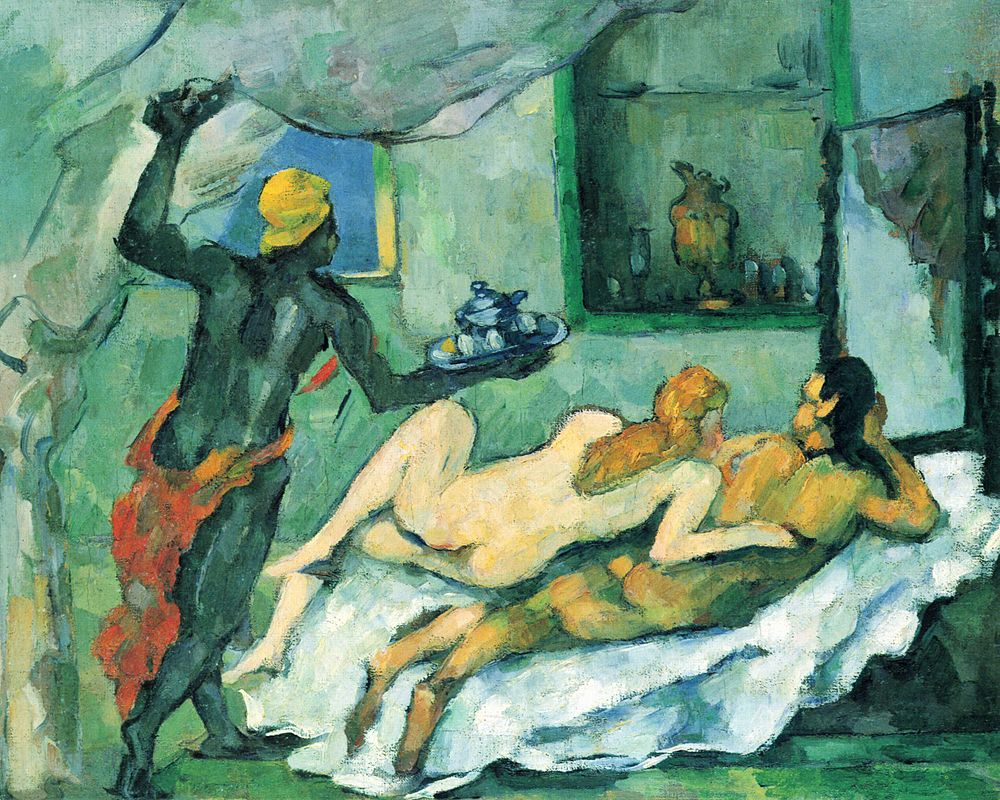
Afternoon in Naples - Cezanne“A human being would certainly not grow to be seventy or eighty years old if this longevity had no meaning for the species. The afternoon of human life must also have a significance of its own and cannot be merely a pitiful appendage to life’s morning.”

Carl Jung

In the final part of my brief series on the subject of home-sickness posted in the run up to Christmas last year I concluded that the malaise to which I had briefly fallen prey that November had been caused in the main by feelings of a loss of significance – a lack of purpose – and of the concomitant confusion concerning my place in the world. I further opined that the topic of ‘significance’ was itself… er… significant and that I would needs return to it in some future disquisition.

Now seems as good a time as any so to do.

As noted in the aforementioned post my emigration to Canada was not the only important event with which I was occupied last summer. I had also reached the end a forty year career in education. I consider myself to have been massively fortunate to have had the opportunity to work in two of the UK’s leading public schools (public in the English sense here) and I felt toward the end that in my primary career in IT (primary in the sense that it was that for which I was most highly rewarded) I had gone about as far as I could go. I had acquired something of a reputation amongst those peers whose opinions I most respected and had little need to prove myself further.

The English public school is an ancient and complex beast – particularly those amongst their number that focus on boarding. These institutions have fashioned an uniquely self-contained and multi-layered culture which incorporates not only the academic, the sporting and the artistic, but also their own individual ethos and mythology. Some go so far as to insinuate into the English language their own vocabulary.

Those who work for these august bodies can choose to hold themselves aloof from such aeon-aged Weltanschauung – or they can cheerfully subscribe thereto. It will surprise no-one that I opted for the latter course, throwing myself into as much of School life as was feasible for one who lived several hours’ drive hence.

I was also for a decade a resident (being joined there in ‘mid-term’ by the Kickass Canada Girl) of a small village in South Buckinghamshire – the sort of rural idyll in which everyone knows everyone else’s business in rather too much detail. I by no means ranked amongst the luminaries (and there were a fair few of them!) but most of them knew who I was.

I served the village for a number of years as secretary to its cricket club. To those for whom the notion of ‘village cricket’ stirs thoughts of amiable amateurishness – or perhaps summons up images redolent of bucolic quaintness – I should point out that within the appellation itself the words ‘village’ and ‘cricket’ get equal billing. Whatever the standard of the play and the good nature and friendliness of the participants, membership of such a club does expose one to all of the pressures and pomposities attendant to rural politics and personalities.

This whole slightly convoluted explication is by way of an illustration as to how the structures that I had (mostly) sub-consciously adopted to support my life in the UK had successfully furnished me with a sense of belonging – a sense of purpose. I knew my place. Nothing out of the ordinary in that, of course… we all do pretty much the same. Reaching the end of a working life can, however, lead to a dislocation from this sense of place as, of course, does moving to a strange country. Doing both at the same time virtually guarantees it and having to start afresh to rediscover one’s sense of worth from scratch can be intimidating. In my case one of the side-effects was my brief bout of home-sickness.

As might be determined from those pre-Christmas posts my response to the malaise was to indulge – as is ever my wont – in a little navel-gazing. Interestingly the topics to which I have alluded above were not the ones that featured most strongly in the resultant retrospection.

Those that were – however – must wait for next time.


Tags: , , , , ,

Heroes

Image by SSgt. F. Lee Corkran, DoD“As you get older it is harder to have heroes, but it is sort of necessary.”

Ernest Hemingway

When an iconic figure – one who regardless of the ceaseless march of the hours and the concomitant diminution of all other childhood heroes, their lustre etiolated with the passage of time – passes from this plane, the event causes a shock to the system no matter how timely that demise might be.

When two such figures succumb within a short space of time it is – with a not entirely disproportionate degree of exaggeration – as though the earth had shifted upon its axis.

I am not going to attempt to pen anything like an appropriate appreciation of the genius of David Bowie. Much has been already been written and can easily be found on the InterWebNet and elsewhere. I will simply state why – in my view – he was one of the most influential and revered of figures in popular music.

Bowie was impossible to characterise or to pin down, whilst at the same time blazing a trail across such a wide range of creative and media forms that a hundred people could admire him and his work and each do so for completely different reasons. In my opinion Bowie’s musical talents and chameleon-like imagination put him on a par with the Beatles – and with no less a luminary than John Lennon. From me there can be no higher praise.

As I say – we each have our own reasons. Being an old-fashioned boy mine are all to do with songwriting; Bowie having composed far more than his fair share of timeless classics. ‘Life on Mars‘, ‘Heroes‘, ‘Fame’, ‘Fashion‘, ‘Ashes to Ashes‘, ‘Loving the Alien‘… I could – quite naturally – go on. This oeuvre was writ large across the soundtrack of my growing years and Bowie was a massive influence on much that I scribbled musically – mayhap sometimes more than was strictly necessary.

David Bowie died at the age of 69 after fighting a battle against cancer…

…as – with fearful symmetry – did a leading light of the current generation of British thespists – Alan Rickman.

Despite the fact that – in the main – I abhor the practice of choosing to see a play, film or television production on the strength of the casting of any particular thespian, I have been known to disregard totally my own rules in the case of certain individuals.

Alan Rickman was one such – for he was an actor who was worth watching even if the vehicle itself were complete rubbish. Who can forget the Kevin Costner vanity project – ‘Robin Hood: Prince of Thieves‘ – from 1991? As Lanre Bakare put it in a Guardian retrospective in 2014:

“Most things about Robin Hood: Prince of Thieves are terrible. Kevin Costner’s and Christian Slater’s attempts at English accents: terrible. Bryan Adam’s theme song which refused to go away during the summer of 1991 and can conjure mass feelings of nausea to this very day: terrible. Seeing Costner’s naked arse as he gets washed in a waterfall: terrible…

...Yes, it’s ridiculous and cliched, but it’s entertaining, and there are some – OK, there’s one – genuinely great performance. Alan Rickman managed to polish one of the 90s cinema’s biggest turds when he put in a brilliant turn as the ruthless Sheriff of Nottingham, who attempts to usurp King John while being held back by his workforce of incompetent jokers and a witch.”

It is truly one of the cinema’s greatest pleasures to watch Rickman acting the ‘star’ of the show off the screen at every turn – and one for which I still occasionally endure reruns thereof.

Rickman would probably prefer to be remembered for his work at the Royal Court and with the Royal Shakespeare Company in the 80s – or perhaps for playing the male lead – the Vicomte de Valmont – in Christopher Hampton’s adaptation of ‘Les Liaisons Dangereuses‘. Younger readers – should any such there be – will know him as Snape from the Harry Potter films.

Whichever role it may be, his presence will be sadly missed. The United Kingdom seems curiously able continually to turn out generations of massively talented actors and actresses – far more than is statistically feasible. That does not mean that we can readily afford to lose the likes of Alan Rickman.

David Bowie – 8 January 1947 – 10 January 2016

Alan Rickman – 21 February 1946 – 14 January 2016

Rest in peace!

Tags: , , ,

Shirley D. Bertoli

1932 – 2015

Our revels are now ended. These our actors,
As I foretold you, were all spirits and
Are melted into air, into thin air:
And like the baseless fabric of this vision,
The cloud-capp’d towers, the gorgeous palaces,
The solemn temples, the great globe itself,
Yea all which it inherit, shall dissolve
And, like this insubstantial pageant faded,
Leave not a rack behind. We are such stuff
As dreams are made on, and our little life
Is rounded in a sleep.

Prospero – from The Tempest, Act IV Scene 1
William Shakespeare 

You can shed tears that she is gone
Or you can smile because she has lived
You can close your eyes and pray that she will come back
Or you can open your eyes and see all that she has left
Your heart can be empty because you can’t see her
Or you can be full of the love that you shared
You can turn your back on tomorrow and live yesterday
Or you can be happy for tomorrow because of yesterday
You can remember her and only that she is gone
Or you can cherish her memory and let it live on
You can cry and close your mind, be empty and turn your back
Or you can do what she would want:
Smile, open your eyes, love and go on.

David Harkins

Tags: ,

Photo by Andy Dawson Reidyear-end also year·end (yîr′ĕnd′)
n.
The end of a year: the value of the account at year-end.
adj.
Occurring or done at the end of the year: a year-end audit.

It is at this time of the year that the Girl and I habitually sit down and look back over the events that have unfolded throughout the preceeding twelve months. It is always good to take stock of what has (or has not) been accomplished and to use this as spur to encourage us onward toward the nascent season ahead.

It need hardly be said that the year just ending has been – to put it mildly – epic! We have retired from the world of work. We have sold up and closed down our existence in the United Kingdom. I have become a Permanent Resident of Canada. We have moved across an ocean and a continent. We have purchased a house. We have instigated the lengthy and complex process of setting up a new life here on the west coast of British Columbia.

Given that all of this is the culmination of a five year project it would not be at all surprising were we to be somewhat overwhelmed by the massive changes that our little lives have undergone. In the event the happenings of the last couple of months have added a momentum of their own which has imbued the end of the year with yet another unexpected twist.

I have already alluded in cryptic manner to an issue that has arisen concerning our house purchase that has required the intervention of the legal profession. As the matter is ongoing I cannot at this stage tell all. Suffice to say that there is an issue with the property that was not disclosed at the time of the sale – though it was known about. Given that considerable expense will now be required to resolve the matter, we are seeking – and are most hopeful of achieving – a suitable settlement with the vendors.

Then – a week before Christmas – we suffered a bereavement. When the Girl’s mother died when she was in her early teens, her mother’s best friend – an honorary aunt – stepped in and effectively raised her from that point on. Such was the robust nature of this exceptional lady that – though well into her eighties – we believed that she might live forever. She was always exceedingly kind and generous to us and we will both miss her terribly. For the Girl this is, naturally, a particularly difficult time.

The Girl was grateful that – by catching the 5:30am flight out of Victoria the Sunday before Christmas – she was able to reach the hospital in Kamloops (her birthplace) in time to say goodbye. She returned to Victoria on the afternoon of Christmas Eve, we entertained on Christmas Day and – early the next morning – took the ferry to the mainland and drove back into the snowy interior of BC for the memorial service. The Girl is joint executor to the estate and we will have to stay in Kamloops for a while helping to sort everything out.

All in all, not how we expected this momentous year to end. Regardless we wish all gentle readers a very Happy New Year, and a prosperous – not to mention hopefully calm – 2016.


Tags: , , , , ,

« Older entries § Newer entries »