| I realise that in all the excitement of my recent visit to BC I neglected to finish the story of my Cajon. I thought you might like to see how it was put together. The main body is glued. The straps are required to allow the glue to set thoroughly to make the joints as strong as possible. | 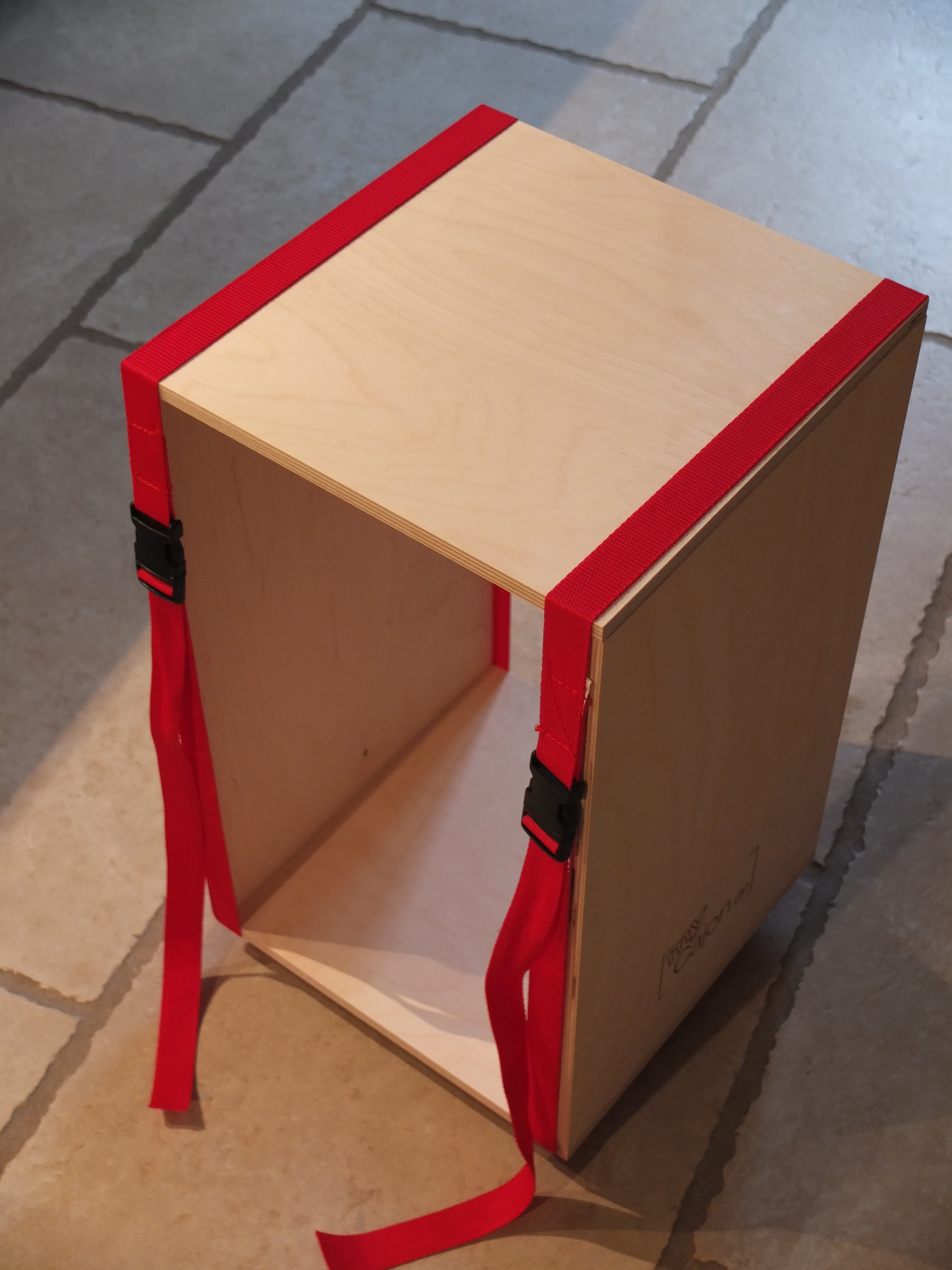 |
| An internal brace is glued to the front of the top of the Cajon. This will carry the snares and support to screwed top of the playing surface. | 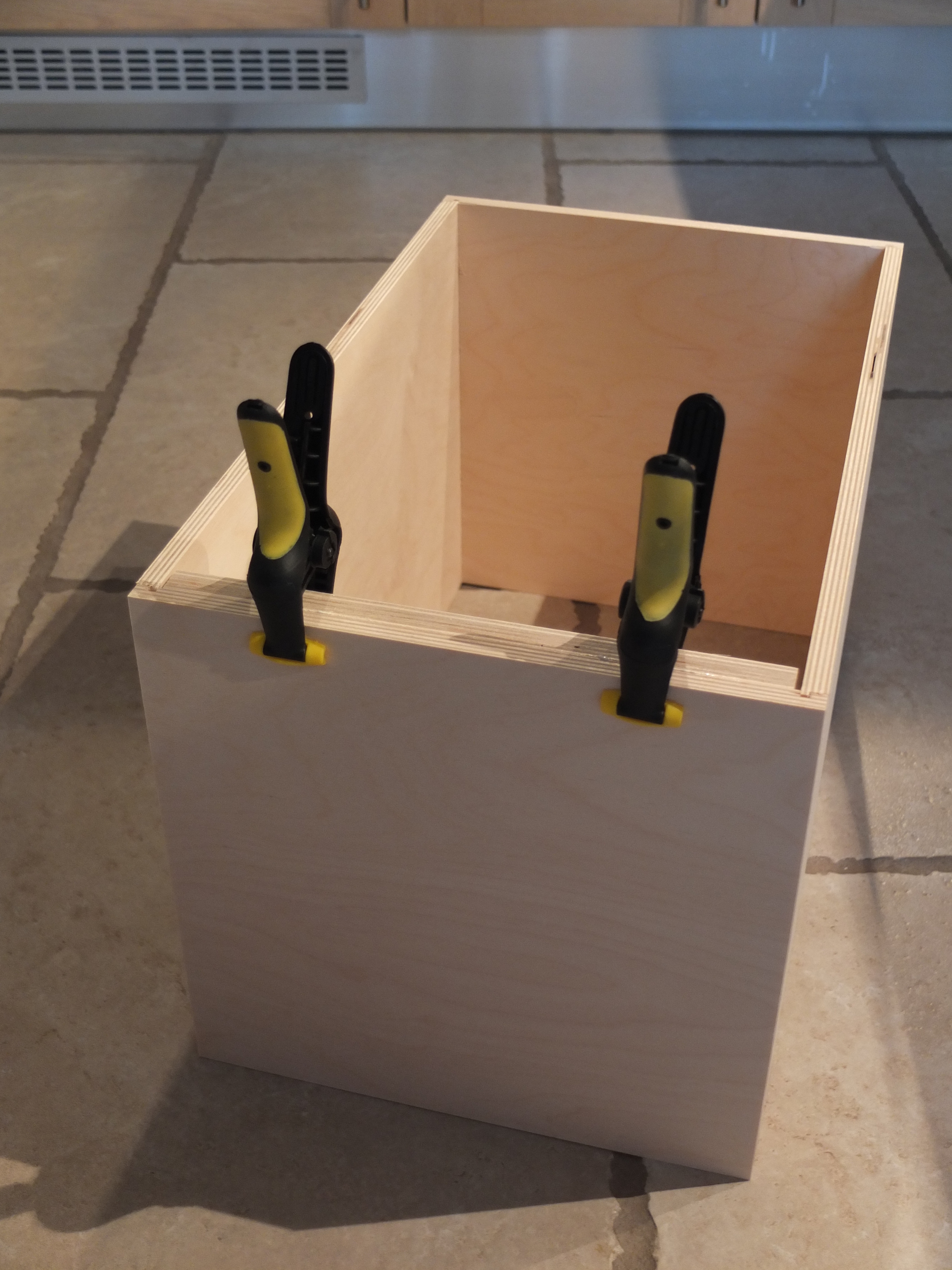 |
| Side braces are required for the parts of the playing surface that are screwed rather than glued. | 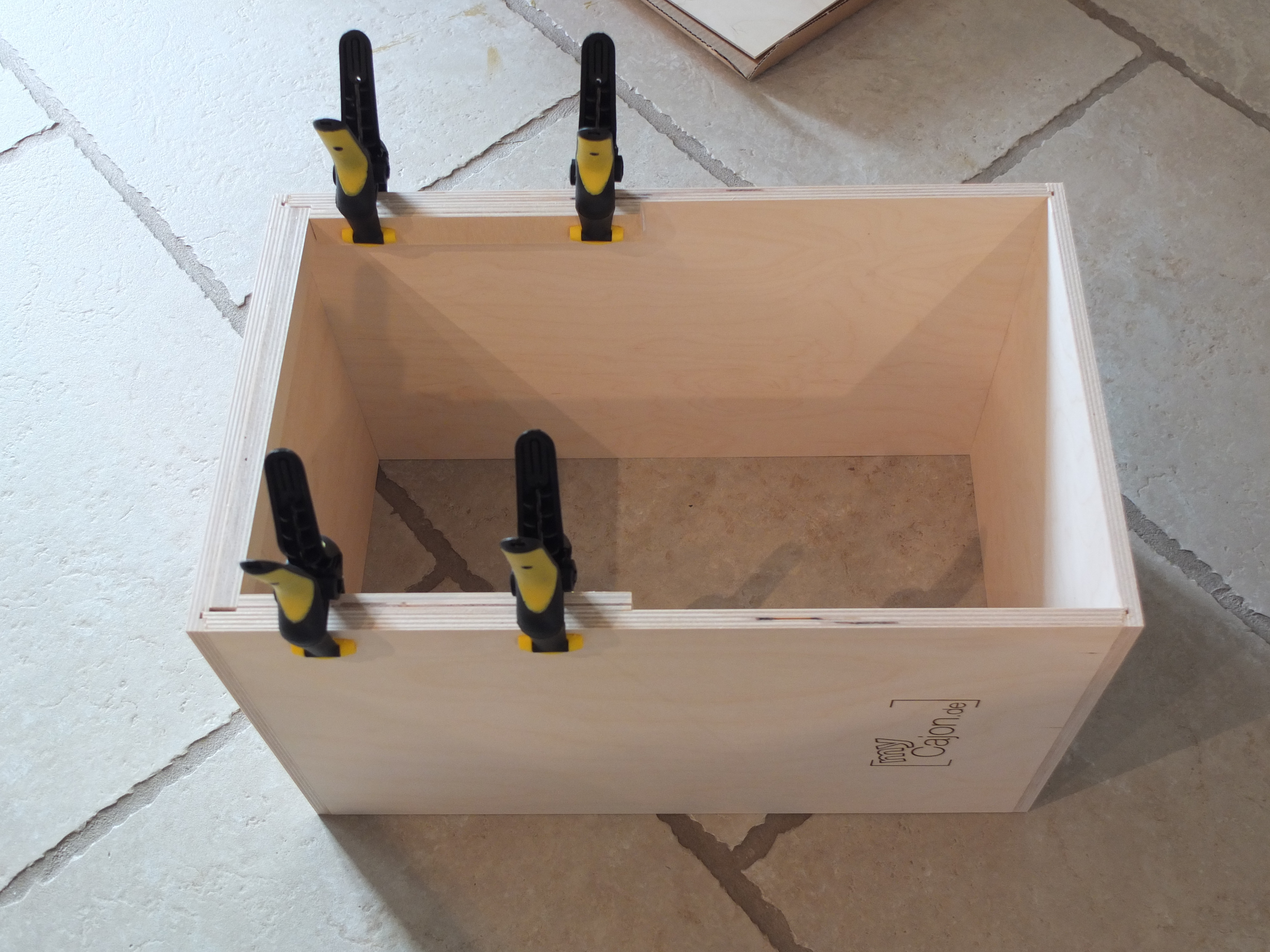 |
| The snares are attached. | 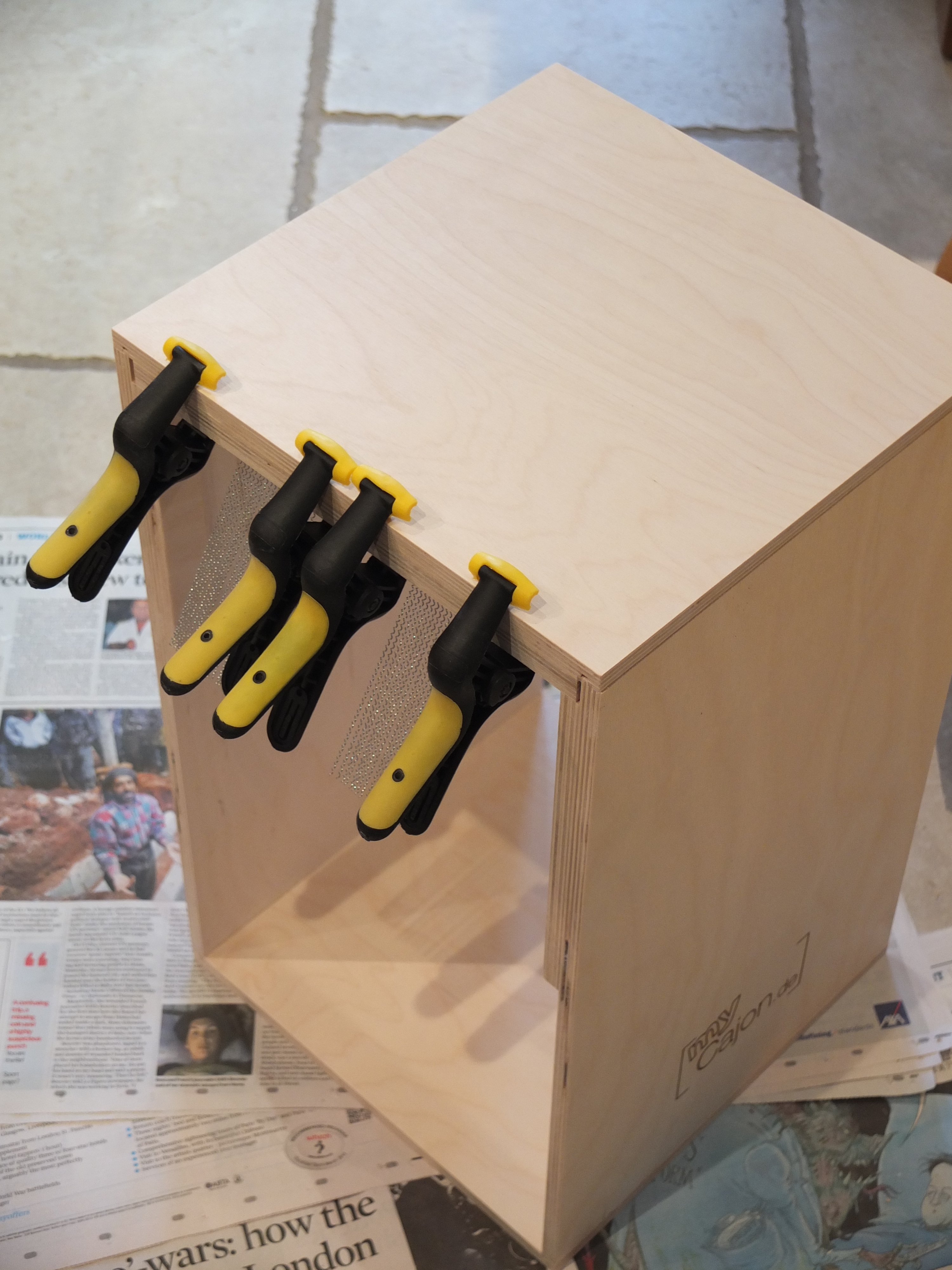 |
| The playing surface and the back of the cajon are now glued in place, though no glue is applied to the top part of the playing surface which is screwed later. This enables it to vibrate freely and to be tuned by tensioning the screws. | 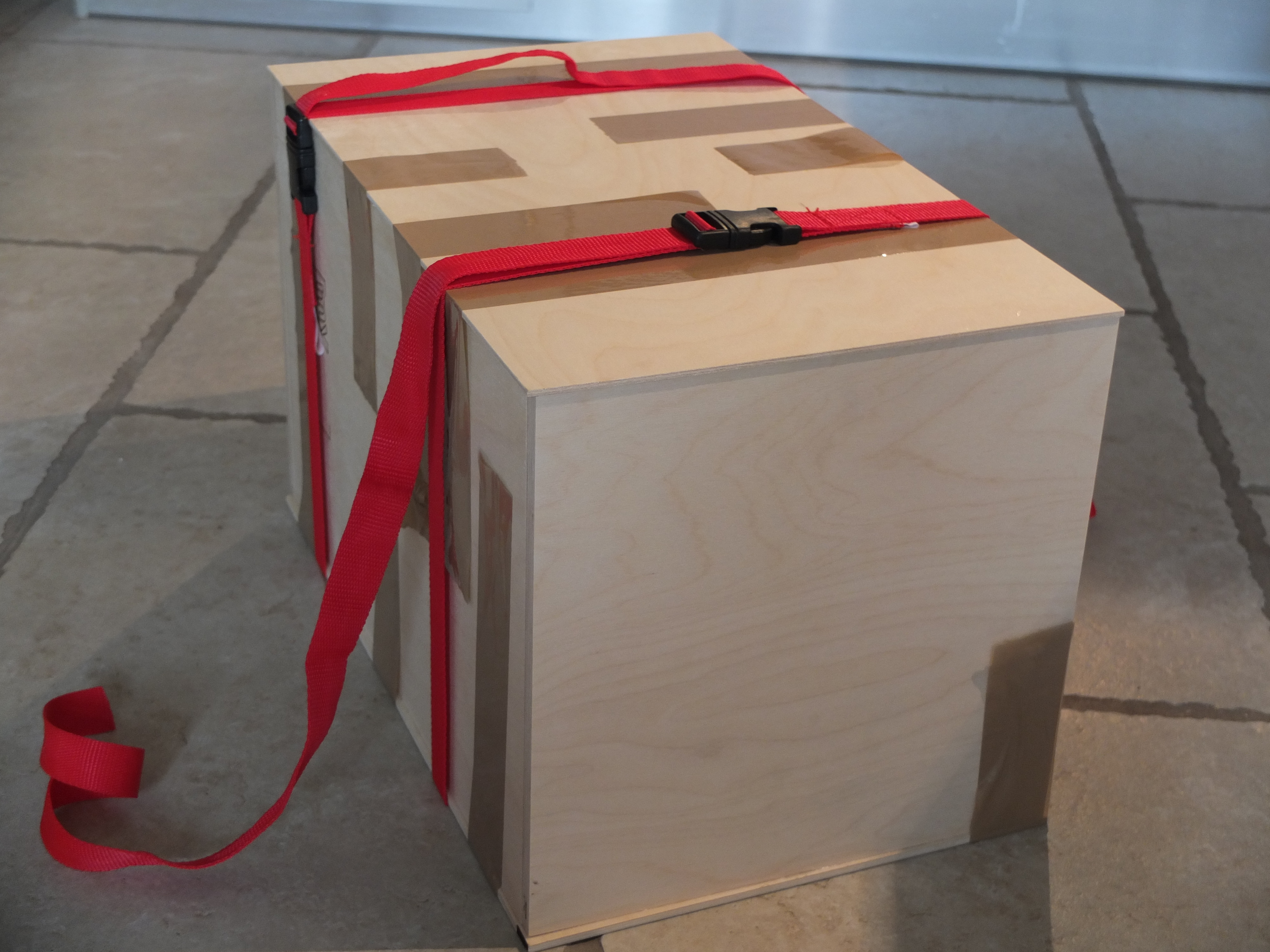 |
| Here is the cajon ready for finishing. The sound hole at the back was cut previously in School on our laser cutter! Very fancy!! | 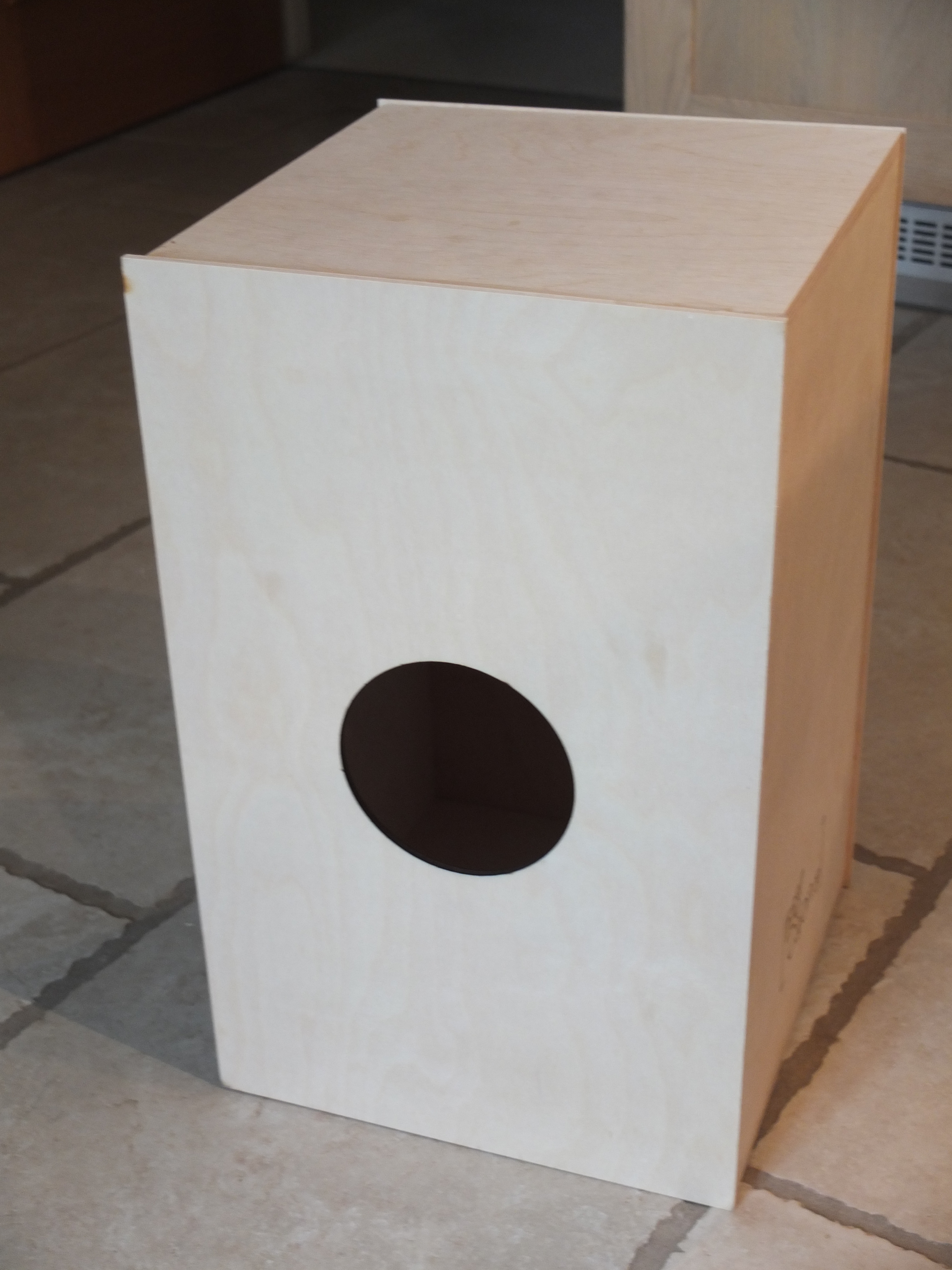 |
| Trimmed, sanded, screwed and given two coats of wax – the cajon is finished and ready for action… | 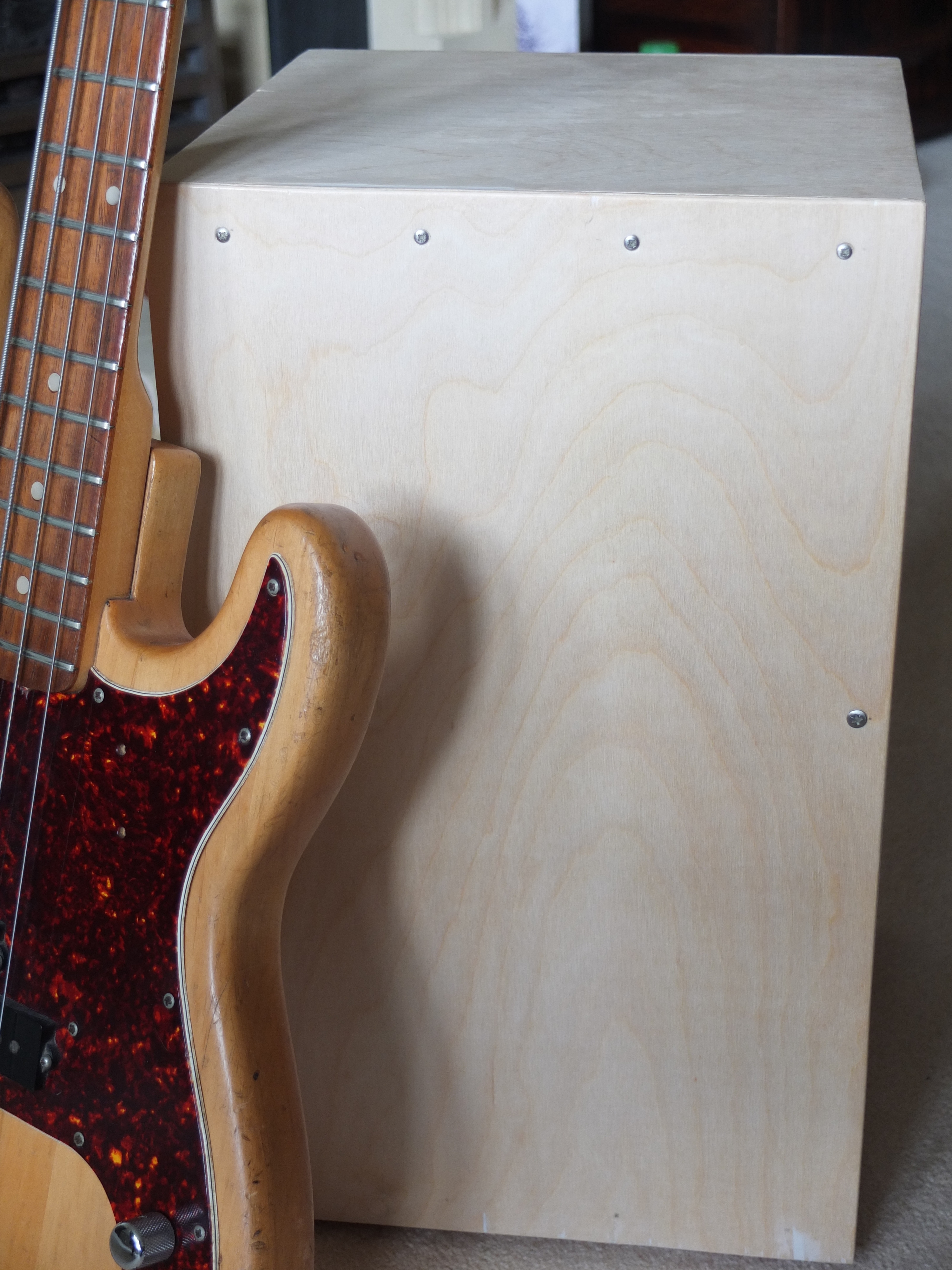 |
Flotsam and Jetsam
If you build it…
 There are a very few films that – no matter how many times I have seen them – if they are on TV I will watch them again. One such is ‘Field of Dreams’. It was showing here in the UK this very afternoon on Freesat, and – yes – I watched it again.
Now – many things could be said about this film. It has been described as a ‘male weepie’ and it is certainly true that it is sentimental (whilst yet avoiding sentimentality) – which in my book is no bad thing. Certainly it makes me blubb like a baby, but I don’t mind that. In fact, to me, the opportunity and ability to blubb like a baby is of considerable import.
The film is also a fantasy that – whilst it does contain, in an almost mythical sense, much truth about our existence – could be considered slight and, perhaps, almost frivolous in the light of harsh reality. That would, in my view, diminish the mythical and thus be a mistake. I will write at greater length about the need for mythologies – of all sorts – on another occasion. Needless to say there is a good reason why films such as this touch a particularly deep nerve whilst in themselves appearing relatively shallow.
The real reason, however, that I can watch ‘Field of Dreams’ over and over again – almost purring with pleasure as I do so – is the sheer quality of Phil Alden Robinson’s screenplay, based as it is on the novel ‘Shoeless Joe’ by W.P. Kinsella. Not only is the script a splendid example of classical screenplay structure, but it is also a perfect illustration of that philosophical oxymoron – less is more! There is barely a single wasted word or spurious notion. The audience is recogised for the intelligent adults that they doubtless are and all impulses to over-explain or to patronise are resisted manfully.
Here is a tiny example:
Ray: Anyway, when I was seventeen we had a big fight, I packed my things, said something awful and left. After a while I wanted to come home, but didn’t know how. I made it back for the funeral.
Mann: What was the awful thing you said?
Ray: I said I could never respect a man whose hero was a criminal.
Mann: Who was his hero?
Ray: Shoeless Joe Jackson.
Mann considers this all very carefully.
Mann: You knew he wasn’t a criminal?
Ray nods.
Mann: Then why’d you say it?
Ray: I was seventeen.
Put the blue crayon back in the pencilbox. Nothing to see here!
Ladies and Gentlemen
 The more astute reader will probably have figured out by now that I work in a school (those who know me will, of course, be well aware of the fact). Now, this is not – it has to be said – just any school. It has a full scale IT Department for one thing (of which I am the director), which should give some idea as to the nature of the establishment. In addition to my managerial and technical duties I also teach drama. This rather unusual mixture is – it need hardly be said – the result of my somewhat eclectic background.
The other day I was talking to the School’s Librarian in the Common Room. She has two sub-librarians who are both also of the fairer sex, a situation apparently not uncommon in their profession. Standing nearby as we talked were two other women – one of our history teachers and a young American graduate who is in the UK for a year on one of the School’s fellowship programmes.
The Librarian and I were discussing the replacement of the software that runs the library catalogue, which upgrade is planned for later this year. I suggested that she and the other ‘ladies’ would know more once they had seen some of the potential alternative systems in action in other schools.
At this point the history teacher interrupted us, politely but firmly, to take me to task for what I had said. I was nonplussed – and expressed same. She explained that I should not have used the term – ‘ladies’. No more ‘plussed’ I inquired as to why this should be so – to be informed that the term is now considered pejorative.
Naturally I apologised for any offence that I might have caused, however inadvertently, and made clear that I had not intended to disparage or condescend in any way. Those who know me would hopefully agree that I have always behaved in the enlightened manner of what was once called the ‘new man’, and have the greatest respect for those of the opposite gender.
I explained that, for me, the terms ‘ladies’ and ‘gentlemen’ have altogether different meanings. I address my staff – who are predominantly male – as ‘gentlemen’ (that I do not do similarly for the sole woman on my team is because neither ‘ladies’ nor ‘gentlemen’ take the singular – at least not in England!), and I do likewise to the boys in my classes – this latter because my fervent hope is that, if they are not already young gentlemen, they will become so by the culmination of their education.
I am not sure that my protestations entirely convinced. I find it somewhat sad that terms that I have always considered a mark of respect should now have gained other connotations. Language is, of course, as much defined by the understanding of the listener as by the intent of the speaker, and it is incumbent on both parties jointly to achieve consensus as to meaning. I fear that all too often this part of the deal is neglected and offence given – or taken – where none is intended.
I would be most interested to hear others’ views on the matter.
I had subsequently an interesting conversation with the American fellow. She told me that she been made much more aware of issues related to sexism since coming to the UK than she had previously been in the US. She was somewhat taken aback by men performing what we might consider acts of politeness – holding doors open and so forth – but even more so that these same men were less able to accept similar in return. She described instances in which she had held open one half of double doors for a man, only to see him push through the other half for himself.
Bizarre!
Playing the odds
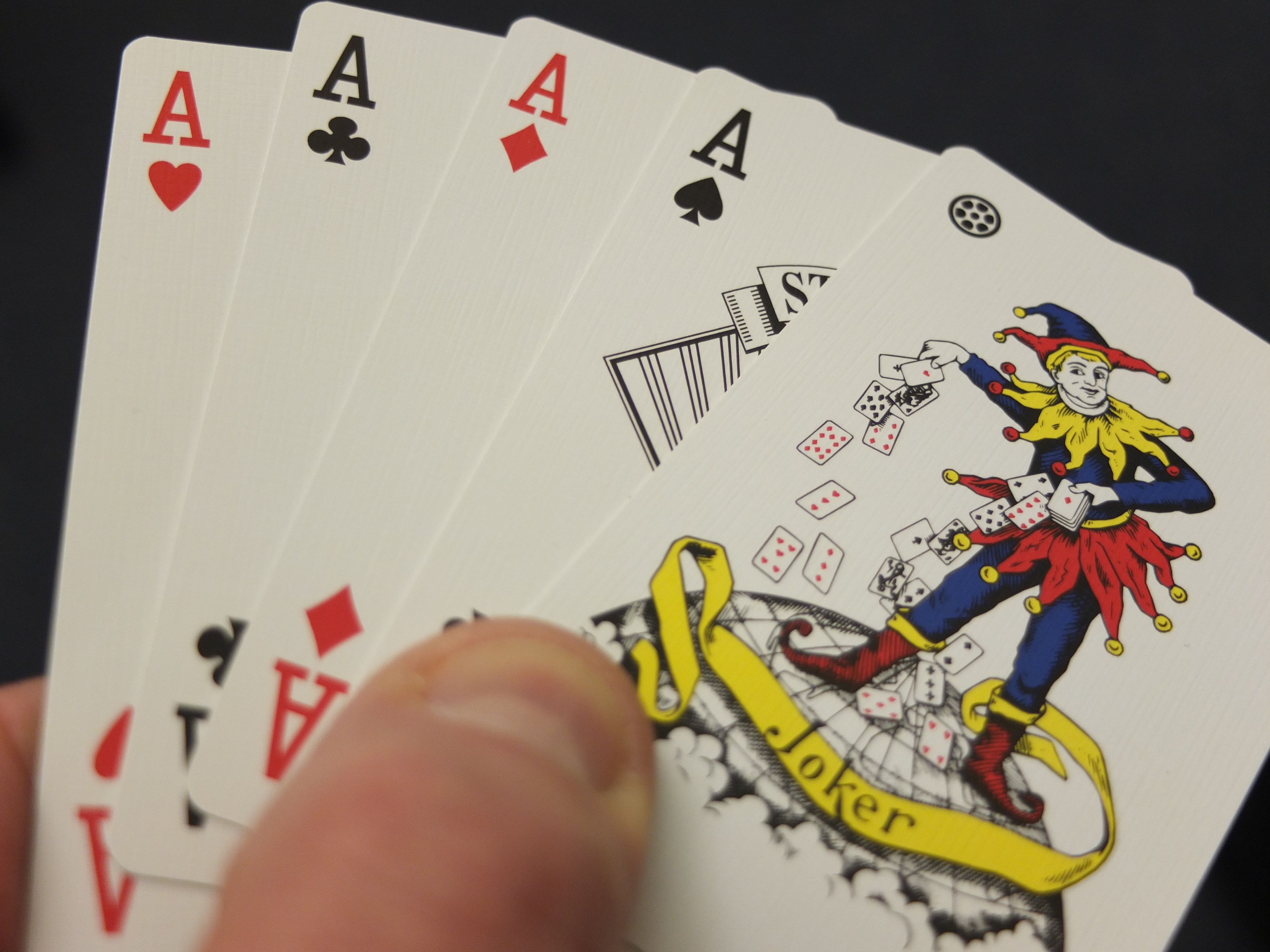 We are – it would seem – fascinated by coincidence. When we read of – or better still, experience for ourselves – some remarkable or unexpected occurrence that seems to defy all the odds, a tingle of excitement runs up the spine – the pulse quickens – the cosmos shifts…
Might this be because we are drawn to the unusual – because we like to see patterns or meanings in the very heart of chaos – or just because the idea of beating the odds appeals to those of us who instinctively support the underdog?
In truth many coincidences – happenings that seem to defy the odds – turn out to be far from unlikely after all. The work colleague whom you encounter unexpectedly on holiday in a foreign land probably comes from a similar background and has similar predilections to you. You have both doubtless studied much the same marketing materials from the tour companies and have reached similar conclusions as to where to take your break.
Consider the well know ‘birthday problem’ from probability theory. This states that, though a gathering would need to comprise 367 people to guarantee that 2 of them share a birthday, only 23 need be present for there to be a 50-50 chance of this happening. To put this another way, in a school with many classrooms each of which contains 23 pupils, approximately half of the rooms would incorporate 2 pupils who share a birthday.
Attempts to ascribe meaning to these or other coincidences are futile. There is no meaning. These things just happen. In this 2007 article from Psychology Today, John Allen Paulos (Professor of Mathematics at Temple University in Philadelphia and best-selling author of Innumeracy: Mathematical Illiteracy and Its Consequences) is quoted thus:
“In reality, the most astonishingly incredible coincidence imaginable would be the complete absence of all coincidence. Believing in the significance of oddities is self-aggrandizing. It says, ‘Look how important I am.’ People find it dispiriting to hear, ‘It just happened, and it doesn’t mean anything.'”
But of course, you don’t really want to read all of this psychological guff – you just want to hear my coincidence story!
The building in which I work includes a good sized atrium which is used on occasion for functions. Just the other day I was returning to my office through the atrium at the first floor level (the second floor if you are Canadian!) and saw that it was being set up for a dinner, with six or seven large round tables each seating 10 diners.
Wondering as to the nature of the event I descended to the floor of the atrium to speak to one of the organisers (whom I know well) who was helping to lay the tables for the dinner. I stopped by the table that she was working on, on the opposite side to where she was. As we chatted she was working her way round the table, putting out place cards at the head of each setting. Reaching the seat immediately in front of me – and without looking at it – she took from her pile and placed on the table a card with my name on it!
As I was definitely not attending the dinner this meant that one of the guests and I share a name – and I don’t just mean a Christian name! The odds on that must be reasonably slim, but those on me standing quite by chance in front of the seat which my namesake would later occupy must be even slimmer.
What might this mean?
I guess it means I should buy a lottery ticket!
New toy!
The working week – coupled with my mammoth commute and with the need to eat and to sleep – does not really leave much time for exploration. I had half an hour last night to play with the x10 and took the chance to experiment a little with some macro shots. Here are a couple of examples.
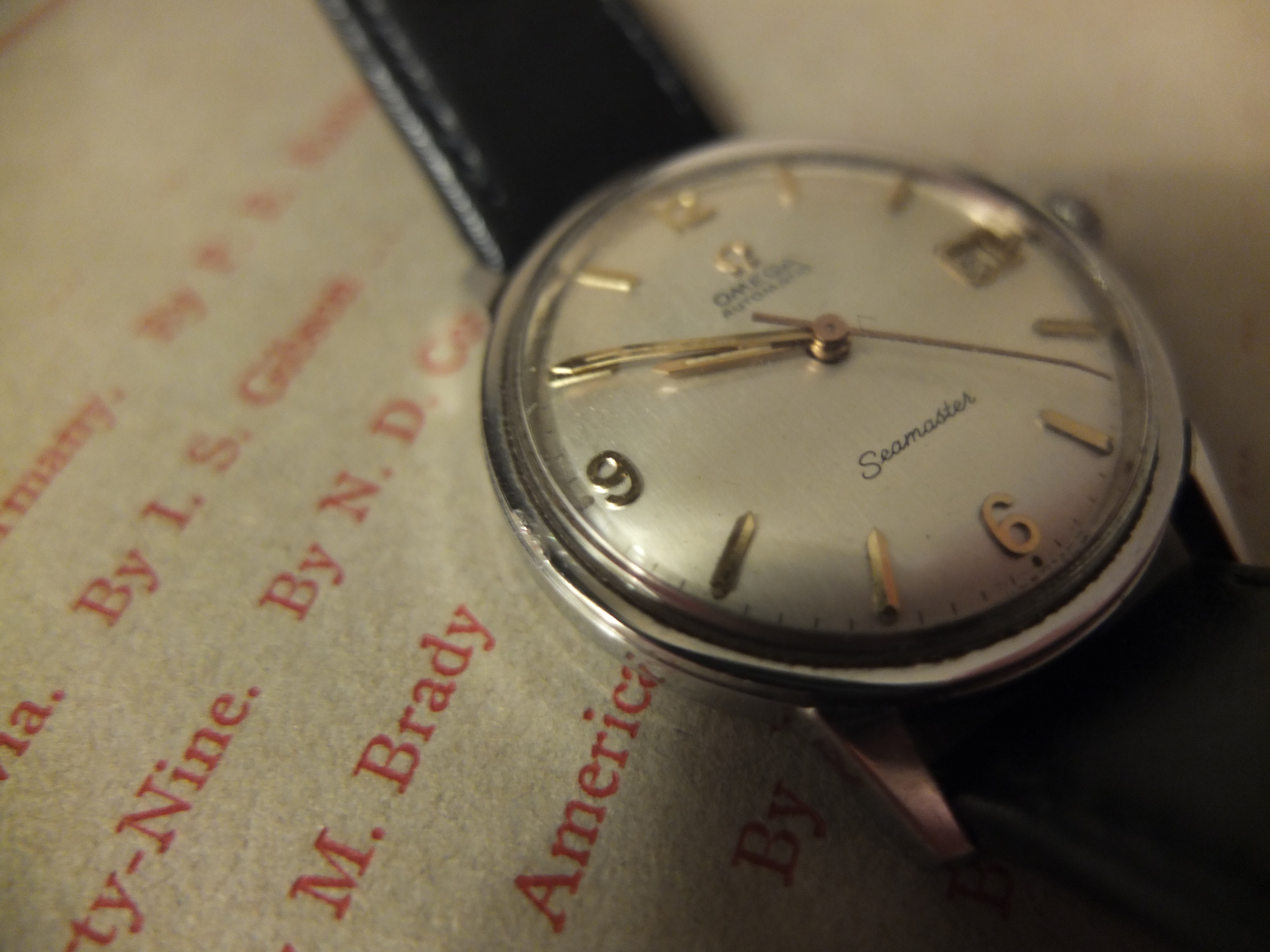
This is a most treasured possession of mine – the 1966 Omega Seamaster that Kickass Canada Girl gave me as a wedding gift. It could do with a new crystal, but it is a thing of beauty and a timeless classic…
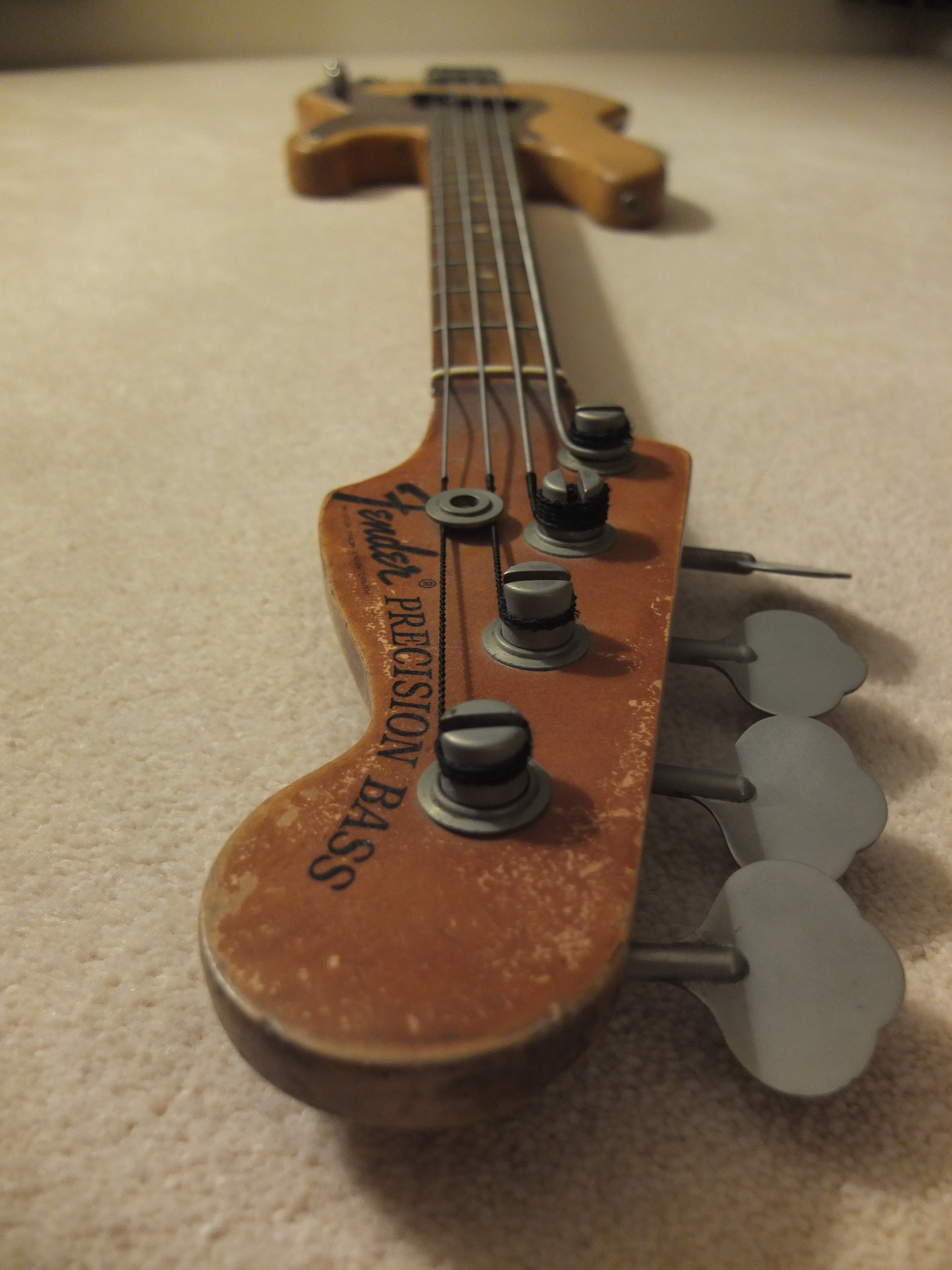
… as is this – my lovely 1976 Fender Precision. Clearly I have a love of things classical!
 Once I have had a chance to really get to grips with the camera I am hoping to be able to produce some pretty decent images.
In Camera
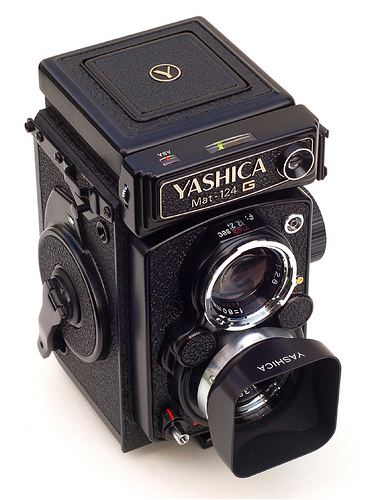 Trying to choose a suitable play on words for the title of this post – with the intention of taking the theme about cameras that commenced here and was extended here to its (quite probably il)logical conclusion… it occurred to me to wonder for the first time in my 58 years as to the origin of the phrase ‘in camera’ – and how it came to mean what it does.
Thank goodness for the InterWebNet! I found this on a most useful site titled Daily Writing Tips:
“The word we use for a “picture-taking device” comes from Latin ‘camera’, “an arched or vaulted roof or room.” The English word chamber, “room,” comes from the same Latin word.”
The link from the domed room to the clever digital device that we now take for granted is the camera obscura – again from the Latin. The Oxford English Dictionary gives the following definition:
camera obscura [L.; lit. ‘dark chamber’]. a. Optics. An instrument consisting of a darkened chamber or box, into which light is admitted through a double convex lens, forming an image of external objects on a surface of paper, glass, etc., placed at the focus of the lens.
There are still a good number of Camera Obscuras in the UK, possibly the best known of which is on the Royal Mile in Edinburgh. I have no idea if there are any in Canada but I would love to hear of such.
The expression ‘in camera’ thus literally means “in the room” – the inference being “privately” or “secretly”. When – for example – a judge calls opposing barristers (attorneys) to meet him “in chambers,” they are meeting ‘in camera’.
Oh yes – I decided to order the Fuji X10. It should be here early next week!
Cajones!
 OMG!!
OMG!!
I have been an enthusiastic amateur musician for more than 40 years, and throughout that time I always believed that I was keeping reasonably well abreast of developments on the music scene.
The other night I was at a school production – a contemporary dance re-interpretation of Purcell’s ‘Dido and Aeneas’, with an updated score in a style which I can only describe as a jazz/blues/classical crossover. This particular production was largely the brainchild of a young man who is the son of a best-selling novelist and journalist, and who led the five piece onstage band on acoustic guitar.
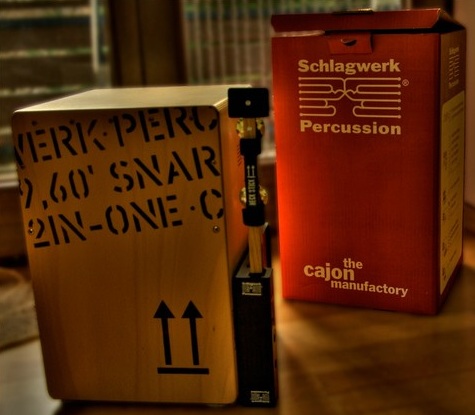
Alongside him was a pianist, a bassist, a violinist and a percussionist. This latter was seated upon – and was hitting with his bare hands – what looked like a small wooden crate. The great surprise was that the sound produced was not that of a man slapping a wooden box, but rather a pretty good facsimile of a drummer playing a decent sized kit. The bass was rich and punchy, the snare crisp and tight, and there was a full range of sounds and colours in between.
Amazing!
For those of you who – like me – have never even heard of a Cajon, let alone seen one in action, this video gives some idea of the possibilities, as does this one – though there really is no substitute for actually hearing one live.
Awesome – and not just in the Canadian usage!
As a compulsive tapper of rhythms on anything handy I think I just might need to acquire one…
Imperceptibly!
 You may have noticed that I have a fondness for language – for its depth and richness and for the infinite variety of its textures and meanings. I love how flexible and elastic it can be and the endless tapestries that can be woven from it. I have no issue with language evolving to meet the demands of new ages, but I do despair if it becomes impoverished by reduction – particularly if such occurs simply through laziness or some form of inverse snobbery.
Clearly ‘imperceptible’ is amongst my favourite words and always makes me think of that great – if apocryphal – theatrical anecdote concerning Samuel Beckett. To cover the somewhat unlikely eventuality that there are those who have not yet heard this story I thought I would include it herein.
Beckett was famously exacting when it came to productions of his work, demanding not only that the text be delivered unadulterated but also that stage directions be followed to the letter.
In 1975 Beckett’s TV play – ‘Ghost Trio’ – was filmed for BBC television. According to the anecdote Beckett himself sat in on the filming, sitting unobtrusively in the shadows at the back of the studio.
One of the early shots in the play includes this stage direction:
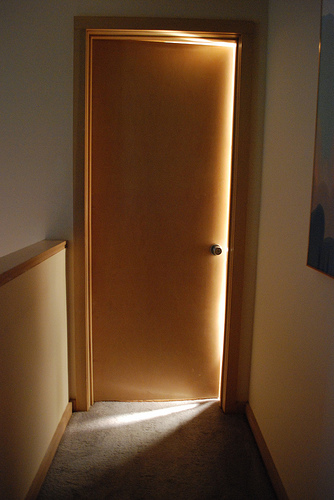
‘Cut to close-up of whole door. Smooth grey rectangle 0.1 x 2 m. Imperceptibly ajar.’
When it came to shooting this scene the director and set designer spent some time on set, nervously discussing the exact positioning of the door and experimenting with various degrees of ‘openness’ – all the while casting anxious glances towards the back of the studio trying to guage Beckett’s reaction. Receiving no guidance from that direction they tried ever finer degrees until finally – unable to stand it any longer – the great man leapt from his seat, stormed onto the set and slammed the door shut.
The director gasped. “But it says ‘ajar’…”, he protested.
“It also”, snapped Beckett, “says ‘imperceptibly’!”.
Camera Obscura
 Aaaaaaargh!!
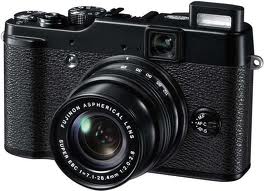
After what feels like literally days surfing the InterWebNet researching cameras in an attempt to meet my somewhat arcane requirements (see here if you would like to know the background to this particular quest) I thought I had finally found one that came close to what I wanted. The Fujifilm X10 is a retro styled advanced compact with just the sort of features I was looking for. Almost panting with excitement – my hand twitching over my credit card like a gunfighter itching to draw – I read on…
Then, to my horror, I started to unearth stories of an apparently fatal design flaw that causes the camera to perform poorly in certain low light conditions, unable to deal in a satisfactory manner with specular highlights. As this was the only camera that remotely met my criteria (assuming that I can’t afford a Leica – which I can’t) I was aghast!
Further reading simply confused the issue. Some reviewers were appalled that a £400 camera could exhibit such flaws – others didn’t mention the problems at all. The posters on some of the more excitable photographic blogs were sufficiently apoplectic that they almost seemed to want to storm Fuji HQ, burn it to the ground and to stone the executives. Others either hadn’t suffered from the defect at all, or if they had did not think it sufficient reason to return the cameras and demand their money back.
It is a very pretty little camera – and I have seen online many excellent examples of images captured by it. Should I just ignore the issues and buy the X10 anyway?
What to do? What to do?…..
I saw my brother last night (Kickass Canada Girl was handing over the sexy Civic to youngest son) but he claimed pressure of work as an excuse for not having yet come up with definitive photographic advice. He had also forgotten to bring the M9 with him which he had intended to show me – though that was probably a good thing!
He has, however, promised to look into it. Watch this space…
Picture Post
 Over the years I have had several bass guitars stolen – one from the back of a van whilst it was being unloaded outside a venue in Edinburgh 20 minutes before the start of a show! I could almost admire the chutzpah required for that particular heist, were it not for the fact that the guitar – my first professional instrument – carried a strong sentimental attachment.
The last time I lost a bass, in the early 90s, I took the insurance cheque and headed for the music stores to replace it. I was in for a shock! Bass guitar technology had changed and I found that I no longer understood it. There were 5 string basses, 6 string basses, extended range basses, acoustic basses, semi-acoustic basses… I couldn’t play any of them! The tide had ebbed and left me behind – driftwood on the strandline.
Fortunately I found a proper old-fashioned guitar shop in Richmond (that is Richmond in the UK – in Surrey… oh, let’s not get confusing!) called – as I recall – Barney Marder’s. Sadly this store is no longer with us, as it used to carry a wonderful collection of old and sometimes rare guitars. There I found a much abused Fender Precision from the mid 70s, in a battered case and with most of the original finish worn away through use. It needed a bit of work but it will – if looked after – see me out.
I am reminded of this episode now because I am looking to purchase a camera. My intention – a good one I think – is to furnish this blog with images that I take myself. Though very much a novice when it comes to photography I do want to try to capture the things that I see and that I write about. The cheap digital camera that I have been using for the last few years does surprisingly well at the basics, but I have a hankering to be able to produce the sort of images that are now so prevalent on the web.
When I was young (painful to write that in so many ways!) there were basically only two types of consumer camera – inexpensive ‘compacts’ that used film cartridges and 35mm SLR jobbies that required flight cases, multiple lenses, filters and all the rest of the paraphernalia. I naively assumed that something similar would still apply, and that to step up I would need to look for the digital equivalent of the 35mm camera – the DSLR. I turned to the Internet to see what might be available.
Another shock! Camera technology has changed and I no longer understand it. Did I want a point and shoot camera, a compact system camera, a bridge/hybrid camera, a 4/3 format camera, a micro 4/3 format camera, an entry-level DSLR, a ‘prosumer’ DSLR… or should I just use the camera in the iThing?… if I had one… which I don’t!
Clearly I have no idea at all as to what I should be looking for. I made a list of what I think are my requirements:
- There has to be a viewfinder of some sort – I don’t like taking pictures at arm’s length
- There has to be manual or semi-automatic control – I like to tell the camera what to do
- There should be dials and buttons rather than just onscreen menus
- It must be possible to shoot in reasonable closeup and at a reasonable distance
- It must be possible to shoot in fairly low light
- The camera should be as simple as possible (no comments please!)
- The whole shooting match should not be too heavy – or I just won’t use it
At this point I consult my brother, who is a designer and who has used cameras professionally ever since he left college. He solved the weight/complexity problem on his first trip to Canada – in the summer of 2010 to attend our wedding – by simply leaving his Hassleblads and DSLRs behind and traveling with an old Leica rangefinder. Mind you, he has just paid an arm and a leg for an M9, so I’m not sure about using him as a role model. Still, he has promised to have a think about it and to get back to me with a recommendation. His younger son is getting Kickass Canada Girl’s car at a knock-down rate when she leaves for BC, so he probably owes me one.