web analytics

A muse of fire…

O for a Muse of fire, that would ascend
The brightest heaven of invention

William Shakespeare

I have long been fascinated by the nature – and the mystery – of creativity.

In one way or another – and for the greater part as an amateur – I have been a writer for as long as I can recall. I have read throughout extensively on the arts of writing and composing but – although I have learned much about technique – I still don’t understand how the muse itself functions. Perhaps no-body does.

In my youth and young adulthood – throughout the 70s and early 80s – I played in bands for which I was often the principle songwriter. Later – through my background as a musician – I became involved with youth theatre, and shortly thereafter started to write musicals. I wrote – or co-wrote – six such shows (including a re-working of Hamlet set in Thatcher’s Britain!) the majority of which were performed at the Edinburgh Festival Fringe. When I ran out of collaborators willing or mad enough to take on such ventures I turned to writing straight plays instead.

One of the great hopes for my retirement to BC is that I will have the time to devote to writing properly. A full length play will currently take me 2 or 3 years to complete (though of course a play is never actually finished) as I have to fit the writing around work, commuting and sleeping – all of which consume far more of my life than does creativity… at least in the temporal sense. I have only once had the opportunity to write ‘full-time’, as it were, when a (sadly) quiet and lonesome Christmas fortnight enabled me to pretty much complete the first draft of an adaptation of Wolfram von Eschenbach’s ‘Parzival’. Sounds pretentious… was a lot of fun!

Recently I have spent a considerable chunk of my spare (ha!) time re-working some of my songs that were written over the past four decades. The driver for this was that my home studio – which at one point was indeed a room full of equipment but which has now shrunk to a single keyboard and a computer – has reached a point in terms of the technology involved that reasonable quality recordings can be made single-handedly and without great expense. Indeed, when now I meet old friends with whom I once played we often find ourselves discussing – somewhat longingly – what we might have achieved had we access to the technology that the young now take for granted.

All this is of course an aside. Back to the muse…

I have not written a new song for nearly 10 years. Until now – that is.

When we stayed – on my recent visit to Victoria – for a week in Oak Bay, it happened that the house in which we were living contained an upright piano. As Kickass Canada Girl had to work on some of the days that we were there I took advantage of being at a loose end to sit at the keyboard and to doodle around (extemporise!) a little. To my surprise a couple of interesting sequences popped out, and when I discovered the following day that I could still recall them quite clearly it became apparent that an new song might be emerging. A 20 minute wait for the Girl in Serious Coffee in Oak Bay Village gave me the subject for the song, and a little further head scratching produced a workable lyric for the first verse and – as a bonus – an idea for the chorus. All of this before she arrived…

Back home in the UK I thought I should see if I could get something down. I have become accustomed to spending a month or more working on a track trying to get a decent recording, but this one sprung to life in no more than a couple of weeks of snatched moments, and that included writing the bridge and instrumental passage that seemed to be required. I have become used to the incidence of happy accidents during the recording process, but in this case they not only all worked out well, but added a couple of layers of meaning to the song that certainly didn’t come from the conscious mind.

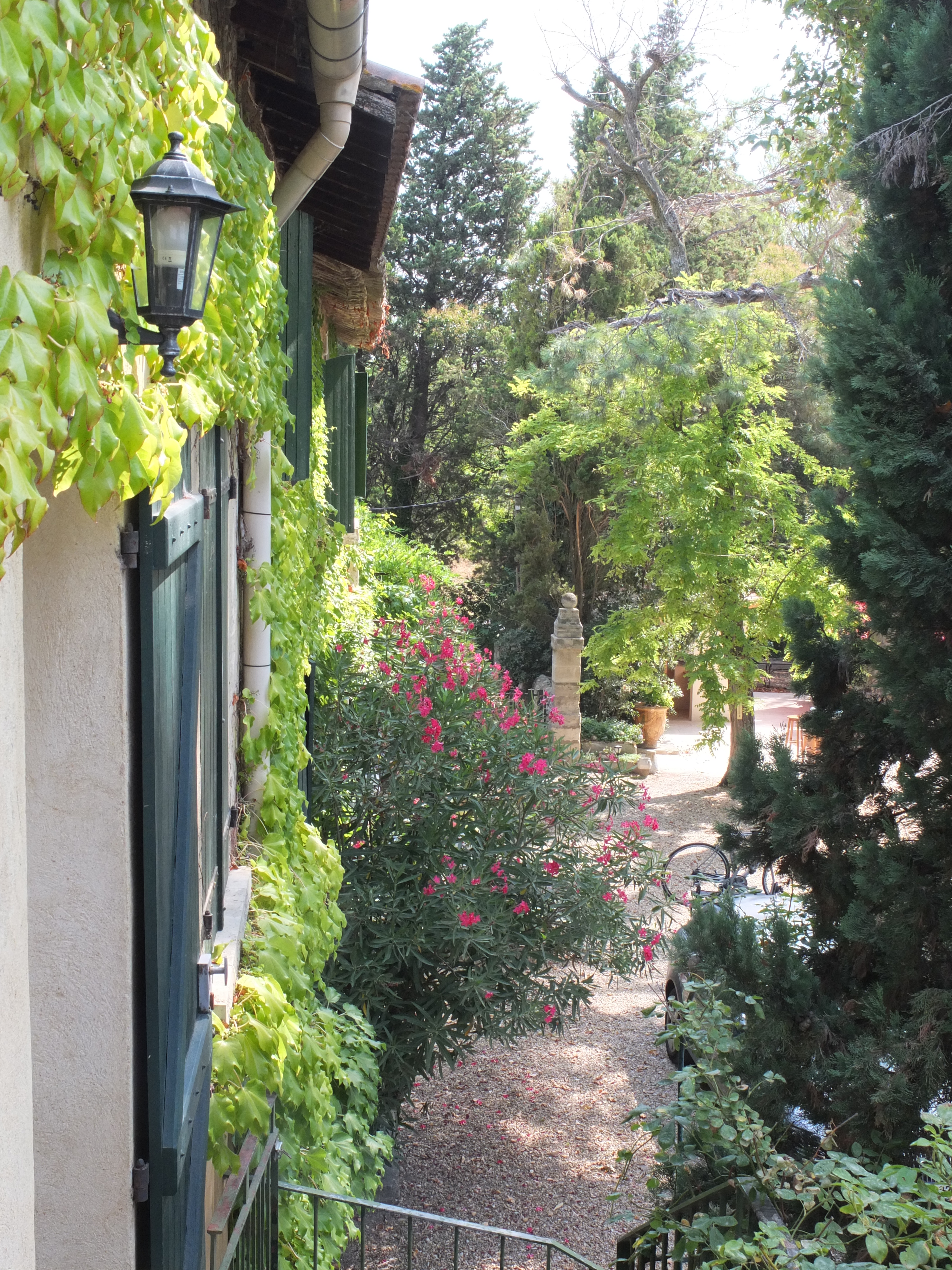
At this point the Girl arrived from BC and we traveled to Provence. I thought I might find a little time to work on some more lyrics but was greatly surprised that – in a spell of no more than 30 minutes yesterday – the rest of the song appeared “as if by magic”! Now all I need to do is to record some vocal tracks (regrettably only with my unfortunately scratchy voice) when I get back to the UK and – hey presto!…

It is not the most original song ever written, but I think it works quite well for what it is. Have I learned anything new about the creative process? Not really – except that one should never, ever think that the muse might have deserted one – no matter how long since one last created. My father – having given up composing when a young man – came back to it in his retirement.

There is definitely a lesson there…

Vive la France!

In about an hour from now (time of writing rather than posting!) Kickass Canada Girl will be touching down at Heathrow. Hooray! I will, of course, be there to meet her.

We are going on Holiday.

Double hooray!!

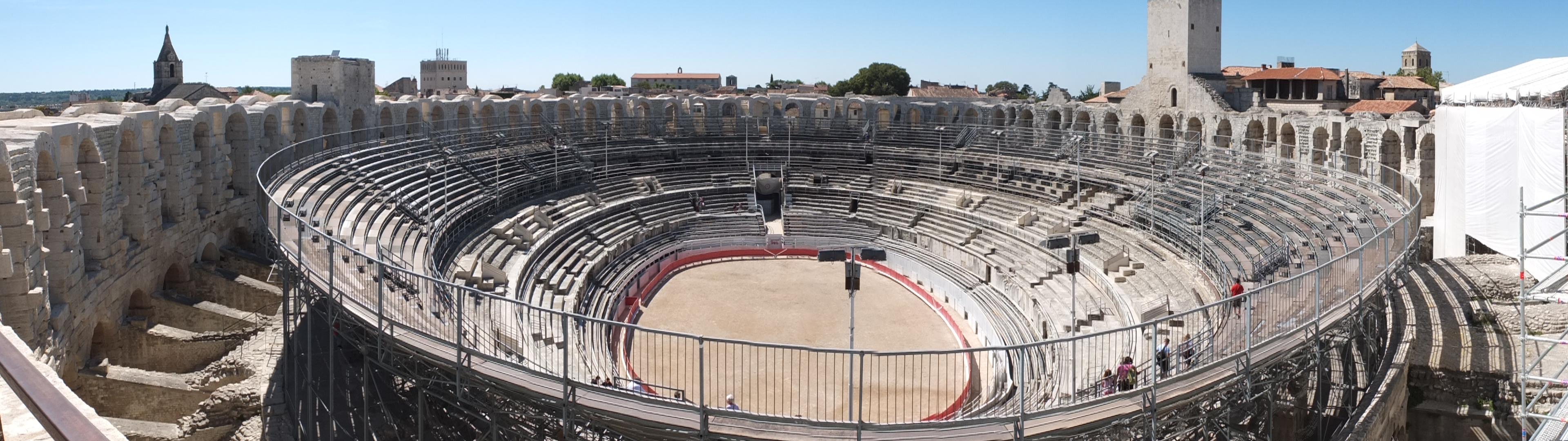
On Friday evening we fly down to Marseilles – in the south of France – and on the Saturday will drive up to Avignon where we will meet our dear friends from Saanich and their two small boys. They are travelling to France independently – and directly – but once we have conjoined there we will be spending a (hopefully) completely relaxed fortnight recovering and recuperating from all the recent trials and tribulations. I can’t wait…

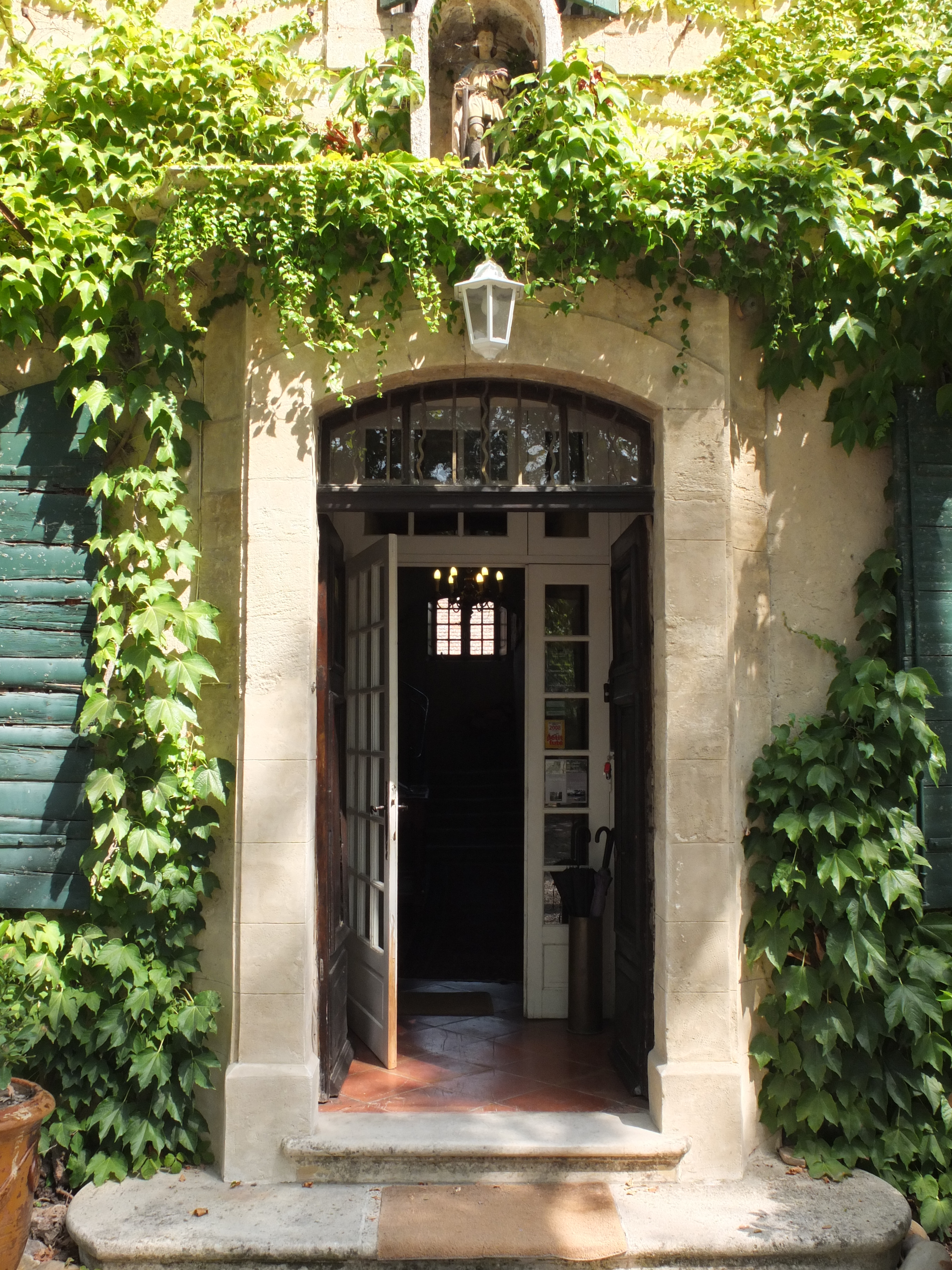
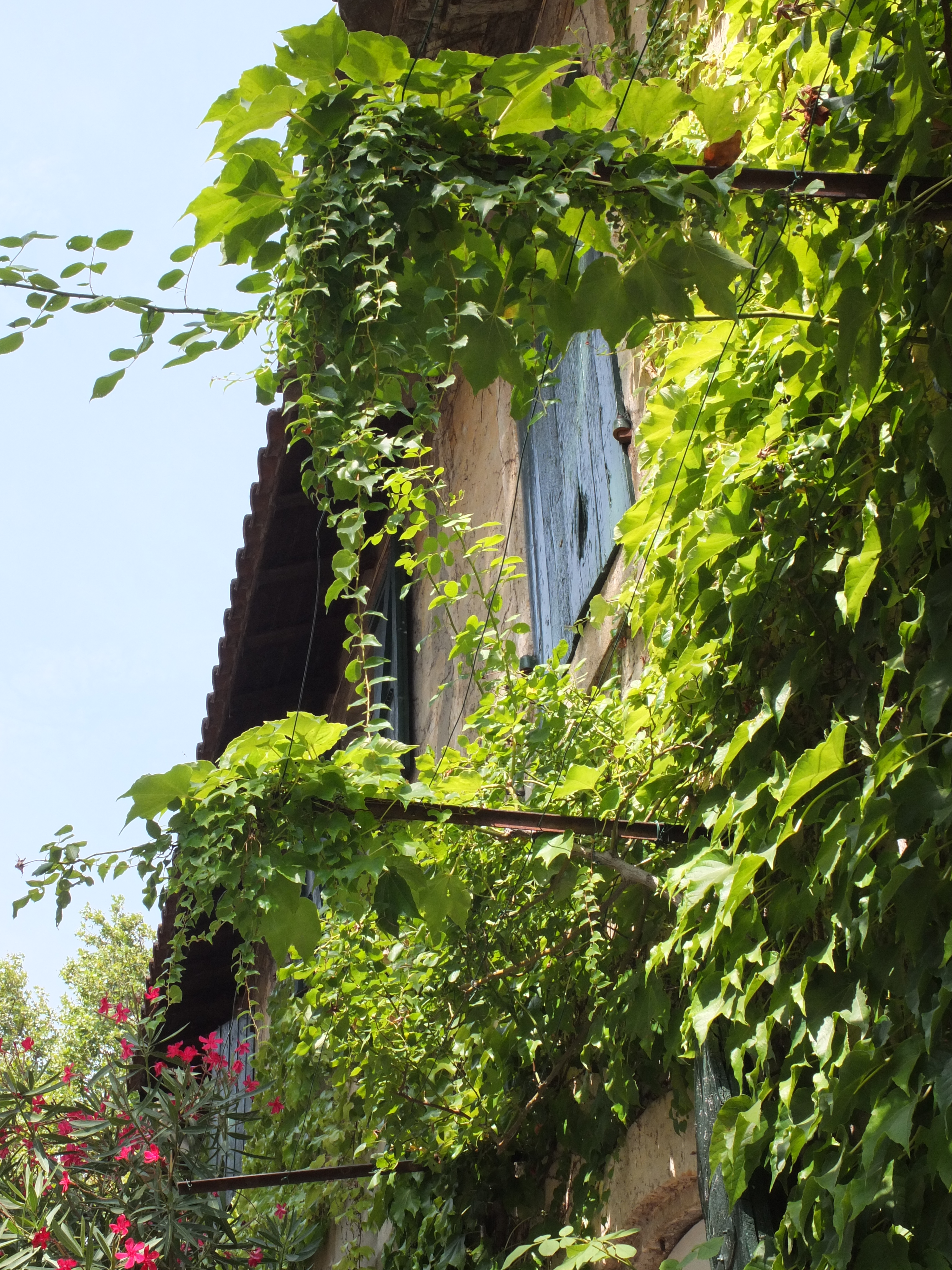
I intend to send images and despatches from Provence if at all possible. The apartments we have booked are equipped with wifi and as long as there are no unexpected hitches I should be able to post some relaxed and contemplative musings on life, the universe and – well – everything!

Hmmm!


The Girl and I also have reason to celebrate as yesterday marked our second wedding anniversary. Strangely whereas, on the one hand, the wedding feels as though it took place only yesterday, at the same time it is as though we have been married forever. I think this must be a good sign – though as I am an optimist I think that everything is a good sign…

Happy days!

The Silent Salesman

“I’d rather trust a man who doesn’t shout what he’s found,
There’s no need to sell if you’re homeward bound.”

Peter Gabriel

Shortly before the end of last term – and my subsequent trip to BC – I was visited by the account manager for the School’s telecom provider. I am responsible for all of the School’s telephony and external data connections and the meeting was really just a routine catch-up, to see how things were going.

A day or so later – immediately before I left for Canada – I had an email from the account manager advising me that she could offer some significant savings if we signed a new three-year deal. As our existing three-year contract was about to expire this made good sense, but I was sufficiently tired and befuddled that I thought it best to take more time and to work through the implications when my head was clearer.

In the jet-lagged period following my return from Victoria our account manager again approached me, enquiring as to whether I had made any progress. Feeling somewhat guilty I admitted that I was still not entirely clear as to any possible ramifications of taking the offer, and asked for further clarification. The account manager offered to visit me again to explain further – an invitation that I gladly accepted.

When she duly arrived – on a glorious and rare 30°C morning – it took her a mere ten minutes or so to dispel any lingering doubts. This left me feeling guilty again, as I had forgotten that she had to drive all the way up to London from the south coast, which journey – given the heat and the traffic restrictions arising from the fast-approaching Olympics – had proved long and arduous. I spun the meeting out to an acceptable length on the entirely unreasonable premise that this might somehow make it seem to have been more worthwhile. She was – it has to be said – entirely equitable about the whole affair.

I walked her back to her car, passing on the way the three-quarters complete Science Building that is the first stage of the School’s major redevelopment programme. I explained that we would need to move all of our external connections – phone and data – to this new building once it had been handed over, and we discussed what would be involved in doing so.

I also mentioned that we had a small number of direct analogue phone circuits – provided by British Telecom rather than our own provider – which service fire alarm panels, security systems and the like. These would also need to be moved. She suggested that we simply install new lines – cancelling the old ones when the transition was complete.

Standing next to her car, a thought occurred to me. I asked her if her company could provide such circuits.

“Yes”, she replied.

I asked what would be the difference between them providing the lines and my ordering them from BT.

“Ours would be cheaper.”

I asked what I would need to do to set things in motion.

“I’ll send you the forms.”

Job done – a potentially tricky problem solved – everything integrated into one contract, and – without my prompting – she wouldn’t have said a word. Now – given that really don’t like being sold to, my question is – is she actually a brilliant sales-person, or just a very lucky one!

I know which my money is on…


The Piper at the Gates of Dawn

A few evenings ago I watched a fascinating TV documentary about Kenneth Grahame and the creation of ‘The Wind in the Willows’. The story is an interesting one, but I was somewhat disappointed that the program made little reference to what seems to me one of the key elements of the book, and to the strange fate that has befallen it.

I have, in a previous post, recommended Jackie Wullschlager’s excellent book ‘Inventing Wonderland’, which is a study of a small group of contemporaneous authors – J. M. Barrie, Lewis Carroll, Kenneth Grahame, A. A. Milne and Edward Lear. The common thread uniting these writers – if you accept Ms Wullschlager’s premise (which I do!) – is that they each contrived to create a classic work of ‘supposed’ children’s fiction whilst themselves exhibiting traits indicative of an inability to fully realise the transition from childhood to adulthood. I say ‘supposed’, of course, because in spite of this exigency these works speak as much (if not more) to adults as they do to children – which may well go a long way to explaining their enduring appeal.

I have a little knowledge of the subject because – half a decade ago and more – I studied in some detail the life of J. M. Barrie. I was writing a play at the time about Barrie and the creation of ‘Peter Pan’ and in the course of my research I happened upon Ms Wullschlager’s book. The play was completed about six months before the frankly inaccurate and overly simplistic Johnny Depp film hit the multiplexes, and you can probably imagine how ‘thrilled’ I was at that particular turn of events!

When it comes to ‘The Wind in the Willows’, however, the background to the book’s creation interests me less than some of the content therein – in particular the seventh chapter – ‘The Piper at the Gates of Dawn’. When I first read the book as a youngster (probably about the same time as first heard an adaptation on the Home Service) it was this section that affected me most. Years later – when shopping for classic children’s books as a gift for the progeny of a friend – I found myself browsing through a lavishly illustrated hardback edition (sadly the illustrations were neither the wonderful originals by E. H. Shepard nor the later Arthur Rackham variants). I scanned the book idly, looking for the familiar prose of my favourite chapter…

…only to find that it was not there!

I looked again – and again! The chapter was missing…

Now – I am aware of only one or two instances in which elements of children’s books have been selectively edited out. I can just about imagine circumstances in which something that was once thought acceptable is no longer deemed to be so – but what on earth could possibly offend in ‘The Wind in the Willows’?

For those not familiar with the book, chapter 7 describes how – one hot, breathless summer night on which no-one can sleep – Ratty and Mole help Otter to search for his missing son, Portly. As dawn nears – after a fruitless night of searching – Ratty is suddenly captivated by the distant sound of ethereal music. Entranced they follow the mystical cadences to their source, where they encounter – on an island in the middle of the stream – a vision of the great god, Pan. The missing Portly is discovered fast asleep between the god’s hooves.

Rosemary Hill – writing in the Guardian in June 2009 – decribes this mysterious chapter thus:

“Those of them who went on searching for the divine often found it enveloped in clouds of pantheism and neo-paganism, spiritualism and theosophy, the faiths of the doubtful. It is this diffuse but potent supernaturalism that appears in The Wind in the Willows in one strange, unsettling chapter, “The Piper at the Gates of Dawn”. It is a section that abridgers of the book have always been quick to drop, though Grahame himself thought it essential” … “Whether it is the latent homo-eroticism of the vision or simply the sudden change of tone that makes the scene so uncomfortable, it is certainly a failure. But while artistically it is the weakest part of the book, it is at the same time the key to it.

There is much to dispute in Ms Hill’s reading, not least the assertion about the ‘faiths of the doubtful’, which – by her tone – I gather she intends pejoratively. I would prefer to substitute ‘sceptical’ – the definitions of which include: “a person who habitually doubts the authenticity of accepted beliefs” and “a person who doubts the truth of religion, esp Christianity”. The InterWebNet offers a plethora of examples of those of established faiths – in particular Christianity – attempting to appropriate the text in support of their own beliefs. This is actually quite offensive. Grahame is far too good a writer: had he intended this interpretation he would have written it.

It is strange that the chapter that Ms Hill describes as a “failure” and “the weakest part of the book” should have had such an effect on me as a child that I habitually look for it first whenever I pick up the book. Grahame is right to consider it essential, and it is indeed – for me – the key to the book. Grahame comes as close as anyone ever has to capturing the essence of the numinous experience. Here Ratty first hears the magical music:

“Rat, who was in the stern of the boat, while Mole sculled, sat up suddenly and listened with a passionate intentness. Mole, who with gentle strokes was just keeping the boat moving while he scanned the banks with care, looked at him with curiosity.

`It’s gone!’ sighed the Rat, sinking back in his seat again. `So beautiful and strange and new. Since it was to end so soon, I almost wish I had never heard it. For it has roused a longing in me that is pain, and nothing seems worth while but just to hear that sound once more and go on listening to it for ever. No! There it is again!’ he cried, alert once more. Entranced, he was silent for a long space, spellbound.

`Now it passes on and I begin to lose it,’ he said presently. `O Mole! the beauty of it! The merry bubble and joy, the thin, clear, happy call of the distant piping! Such music I never dreamed of, and the call in it is stronger even than the music is sweet! Row on, Mole, row! For the music and the call must be for us.'”

…and after their encounter with the god…

“Sudden and magnificent, the sun’s broad golden disc showed itself over the horizon facing them; and the first rays, shooting across the level water-meadows, took the animals full in the eyes and dazzled them. When they were able to look once more, the Vision had vanished, and the air was full of the carol of birds that hailed the dawn.

As they stared blankly. in dumb misery deepening as they slowly realised all they had seen and all they had lost, a capricious little breeze, dancing up from the surface of the water, tossed the aspens, shook the dewy roses and blew lightly and caressingly in their faces; and with its soft touch came instant oblivion. For this is the last best gift that the kindly demi- god is careful to bestow on those to whom he has revealed himself in their helping: the gift of forgetfulness. Lest the awful remembrance should remain and grow, and overshadow mirth and pleasure, and the great haunting memory should spoil all the after-lives of little animals helped out of difficulties, in order that they should be happy and lighthearted as before.”

This is not merely Edwardian whimsy, nor some failed attempt at a search for the supernatural. ‘The Wind in The Willows’ is about Longing and Loss (which – along with Love – are the three great subjects of all art) written during a golden summer in which everything seemed possible, but at the zenith of which everything might also be lost – as indeed proved to be the case as the world spiralled into the maelstrom of the new century.


A different drum

I realise that in all the excitement of my recent visit to BC I neglected to finish the story of my Cajon. I thought you might like to see how it was put together. The main body is glued. The straps are required to allow the glue to set thoroughly to make the joints as strong as possible.
An internal brace is glued to the front of the top of the Cajon. This will carry the snares and support to screwed top of the playing surface.
Side braces are required for the parts of the playing surface that are screwed rather than glued.
The snares are attached.
The playing surface and the back of the cajon are now glued in place, though no glue is applied to the top part of the playing surface which is screwed later. This enables it to vibrate freely and to be tuned by tensioning the screws.
Here is the cajon ready for finishing. The sound hole at the back was cut previously in School on our laser cutter! Very fancy!!
Trimmed, sanded, screwed and given two coats of wax – the cajon is finished and ready for action…

If you build it…

There are a very few films that – no matter how many times I have seen them – if they are on TV I will watch them again. One such is ‘Field of Dreams’. It was showing here in the UK this very afternoon on Freesat, and – yes – I watched it again.

Now – many things could be said about this film. It has been described as a ‘male weepie’ and it is certainly true that it is sentimental (whilst yet avoiding sentimentality) – which in my book is no bad thing. Certainly it makes me blubb like a baby, but I don’t mind that. In fact, to me, the opportunity and ability to blubb like a baby is of considerable import.

The film is also a fantasy that – whilst it does contain, in an almost mythical sense, much truth about our existence – could be considered slight and, perhaps, almost frivolous in the light of harsh reality. That would, in my view, diminish the mythical and thus be a mistake. I will write at greater length about the need for mythologies – of all sorts – on another occasion. Needless to say there is a good reason why films such as this touch a particularly deep nerve whilst in themselves appearing relatively shallow.

The real reason, however, that I can watch ‘Field of Dreams’ over and over again – almost purring with pleasure as I do so – is the sheer quality of Phil Alden Robinson’s screenplay, based as it is on the novel ‘Shoeless Joe’ by W.P. Kinsella. Not only is the script a splendid example of classical screenplay structure, but it is also a perfect illustration of that philosophical oxymoron – less is more! There is barely a single wasted word or spurious notion. The audience is recogised for the intelligent adults that they doubtless are and all impulses to over-explain or to patronise are resisted manfully.

Here is a tiny example:


Ray: Anyway, when I was seventeen we had a big fight, I packed my things, said something awful and left. After a while I wanted to come home, but didn’t know how. I made it back for the funeral.

Mann: What was the awful thing you said?

Ray: I said I could never respect a man whose hero was a criminal.

Mann:  Who was his hero?

Ray:  Shoeless Joe Jackson.

Mann considers this all very carefully.

Mann:  You knew he wasn’t a criminal?

Ray nods.

Mann:  Then why’d you say it?

Ray:  I was seventeen.


Put the blue crayon back in the pencilbox. Nothing to see here!


Ladies and Gentlemen

The more astute reader will probably have figured out by now that I work in a school (those who know me will, of course, be well aware of the fact). Now, this is not – it has to be said – just any school. It has a full scale IT Department for one thing (of which I am the director), which should give some idea as to the nature of the establishment. In addition to my managerial and technical duties I also teach drama. This rather unusual mixture is – it need hardly be said – the result of my somewhat eclectic background.

The other day I was talking to the School’s Librarian in the Common Room. She has two sub-librarians who are both also of the fairer sex, a situation apparently not uncommon in their profession. Standing nearby as we talked were two other women – one of our history teachers and a young American graduate who is in the UK for a year on one of the School’s fellowship programmes.

The Librarian and I were discussing the replacement of the software that runs the library catalogue, which upgrade is planned for later this year. I suggested that she and the other ‘ladies’ would know more once they had seen some of the potential alternative systems in action in other schools.

At this point the history teacher interrupted us, politely but firmly, to take me to task for what I had said. I was nonplussed – and expressed same. She explained that I should not have used the term – ‘ladies’. No more ‘plussed’ I inquired as to why this should be so – to be informed that the term is now considered pejorative.

Naturally I apologised for any offence that I might have caused, however inadvertently, and made clear that I had not intended to disparage or condescend in any way. Those who know me would hopefully agree that I have always behaved in the enlightened manner of what was once called the ‘new man’, and have the greatest respect for those of the opposite gender.

I explained that, for me, the terms ‘ladies’ and ‘gentlemen’ have altogether different meanings. I address my staff – who are predominantly male – as ‘gentlemen’ (that I do not do similarly for the sole woman on my team is because neither ‘ladies’ nor ‘gentlemen’ take the singular – at least not in England!), and I do likewise to the boys in my classes – this latter because my fervent hope is that, if they are not already young gentlemen, they will become so by the culmination of their education.

I am not sure that my protestations entirely convinced. I find it somewhat sad that terms that I have always considered a mark of respect should now have gained other connotations. Language is, of course, as much defined by the understanding of the listener as by the intent of the speaker, and it is incumbent on both parties jointly to achieve consensus as to meaning. I fear that all too often this part of the deal is neglected and offence given – or taken – where none is intended.

I would be most interested to hear others’ views on the matter.


I had subsequently an interesting conversation with the American fellow. She told me that she been made much more aware of issues related to sexism since coming to the UK than she had previously been in the US. She was somewhat taken aback by men performing what we might consider acts of politeness – holding doors open and so forth – but even more so that these same men were less able to accept similar in return. She described instances in which she had held open one half of double doors for a man, only to see him push through the other half for himself.

Bizarre!

Playing the odds

We are – it would seem – fascinated by coincidence. When we read of – or better still, experience for ourselves – some remarkable or unexpected occurrence that seems to defy all the odds, a tingle of excitement runs up the spine – the pulse quickens – the cosmos shifts…

Might this be because we are drawn to the unusual – because we like to see patterns or meanings in the very heart of chaos – or just because the idea of beating the odds appeals to those of us who instinctively support the underdog?

In truth many coincidences – happenings that seem to defy the odds – turn out to be far from unlikely after all. The work colleague whom you encounter unexpectedly on holiday in a foreign land probably comes from a similar background and has similar predilections to you. You have both doubtless studied much the same marketing materials from the tour companies and have reached similar conclusions as to where to take your break.

Consider the well know ‘birthday problem’ from probability theory. This states that, though a gathering would need to comprise 367 people to guarantee that 2 of them share a birthday, only 23 need be present for there to be a 50-50 chance of this happening. To put this another way, in a school with many classrooms each of which contains 23 pupils, approximately half of the rooms would incorporate 2 pupils who share a birthday.

Attempts to ascribe meaning to these or other coincidences are futile. There is no meaning. These things just happen. In this 2007 article from Psychology Today, John Allen Paulos (Professor of Mathematics at Temple University in Philadelphia and best-selling author of Innumeracy: Mathematical Illiteracy and Its Consequences) is quoted thus:

“In reality, the most astonishingly incredible coincidence imaginable would be the complete absence of all coincidence. Believing in the significance of oddities is self-aggrandizing. It says, ‘Look how important I am.’ People find it dispiriting to hear, ‘It just happened, and it doesn’t mean anything.'”


But of course, you don’t really want to read all of this psychological guff – you just want to hear my coincidence story!


The building in which I work includes a good sized atrium which is used on occasion for functions. Just the other day I was returning to my office through the atrium at the first floor level (the second floor if you are Canadian!) and saw that it was being set up for a dinner, with six or seven large round tables each seating 10 diners.

Wondering as to the nature of the event I descended to the floor of the atrium to speak to one of the organisers (whom I know well) who was helping to lay the tables for the dinner. I stopped by the table that she was working on, on the opposite side to where she was. As we chatted she was working her way round the table, putting out place cards at the head of each setting. Reaching the seat immediately in front of me – and without looking at it – she took from her pile and placed on the table a card with my name on it!

As I was definitely not attending the dinner this meant that one of the guests and I share a name – and I don’t just mean a Christian name! The odds on that must be reasonably slim, but those on me standing quite by chance in front of the seat which my namesake would later occupy must be even slimmer.

What might this mean?

I guess it means I should buy a lottery ticket!

New toy!

The working week – coupled with my mammoth commute and with the need to eat and to sleep – does not really leave much time for exploration. I had half an hour last night to play with the x10 and took the chance to experiment a little with some macro shots. Here are a couple of examples.

This is a most treasured possession of mine – the 1966 Omega Seamaster that Kickass Canada Girl gave me as a wedding gift. It could do with a new crystal, but it is a thing of beauty and a timeless classic…

… as is this – my lovely 1976 Fender Precision. Clearly I have a love of things classical!

Once I have had a chance to really get to grips with the camera I am hoping to be able to produce some pretty decent images.