web analytics

Modern life

You are currently browsing articles tagged Modern life.

Photo by Andy Dawson ReidIn the first part of ‘Not fit for purpose‘ I wrote of the Universal Declaration on Human Rights (UDHR) and of how, through the later Cairo Declaration on Human Rights in Islam (CDHRI), many of the Islamic states effectively opted out of any agreement to comply with the articles therein.

Lest anyone think that this be a polemic against the Islamic world alone let me be clear that I extend my critique to all states – be they based in religious or political dogma – that wilfully ignore the efforts of the international community to evolve a modus operandi by which the nations of the world might live at peace with one another. Putin’s Russia – as an example – is certainly not alone amongst secular states in displaying a fine disregard for the rights of others.

My discourse on the UDHR was – however – intended only as an introduction to the topic that I really want to address… that of the urgent need to find a way to prevent extremists of any hue from being able to co-opt the tenets and principles of faiths or political movements to suit their own despicable agendas – as happened the week  before last in Paris. This does – of course – presuppose the veracity of the condemnations of such atrocities as expressed by those whose beliefs and ideals have been traduced. Far be it from me to suggest that there might be occasions on which those who denounce the terrorists in public secretly support their actions in private – or at the very least sympathise with them.

The routes to radicalisation are complex and varied, and countries around the globe have thus far struggled to find ways to integrate those of contrary racial and religious backgrounds in such a way that the resentments and discrimination that can lead to ghettoisation and violence do not find fertile ground in which to breed. Whether these attempts follow the paths of multiculturalism or integration the results have, frankly, not been promising. Prejudice and poverty can be all to easily exploited by the dark forces that seek to prey upon those vulnerable to indoctrination.

Whereas it would be entirely iniquitous to hold religions or political movements responsible for the actions of the misguided minority who violate their teachings or beliefs – or indeed to expect those who follow these tenets in good faith to offer a solution to a problem that is not of their making – it would certainly assist matters if it were considerably more difficult than it is currently for the extremists to debase doctrines and dogmas in pursuit of their own agendas. In an entirely rational world this would involve revisiting and revising sacred and political texts and screeds to ensure that they do not contain ambiguities that might be so exploited.

The suggestion that ancient religious scriptures should be reworked would doubtless raise howls of protest – particularly from those who believe their own faith’s tenets to be carved in tablets of stone… this in spite of the fact that in virtually all instances the texts as we now know them are demonstrably the work of multiple authors and only took their current forms considerably later than the time that it is purported that they were written. It seems somewhat ironic that such canons have become progressively less flexible with regard to interpretation as the pace of change throughout the world outside has increased.

If such revision proves – as seems inevitable – too much to ask, then we should at least require – in the event of this sort of malign traduction – that those who deem themselves to be the guardians of such beliefs issue definitive interpretations of the tracts concerned – so that those on all sides who might otherwise become innocent victims of the extremists be offered at least some protection.

Failure to take any action simply re-inforces the view that such scriptures, screeds and dogmas be no longer fit for purpose in the modern world.


Tags: , ,

Image by Julian Colton on Wikimedia CommonsMy last screed – posted in the immediate aftermath of the Charlie Hebdo murders in Paris – posited that further comment should perhaps wait until there had been some time for calm contemplation. This – of course – because the initial surge of emotion experienced might just have caused me to asseverate something in print that I might later have regretted.

That time has passed. One and a half have million people have shown their solidarity – on the wintery streets of Paris – with the victims of this crime and with the principles for which they stood. Much of great wisdom has been said and written regarding these terrible events by those vastly more qualified so to do than I. Though there are no easy answers I am well aware that those who burn to understand how such a tragedy could have come about in this day and age in one of the world’s great capitals will already have spent much time reading and researching. They will learn little that is new or of value from me.

This will, naturally, not stop me from addressing at least one issue – so if you feel inclined – read on… if not – feel free to move on!


In the course of an address in October 1995 the then Pope – John Paul II – described the Universal Declaration of Human Rights (UDHR) as “one of the highest expressions of the human conscience of our time”. Indeed the document – drafted by more than a dozen representatives from around the world and approved by the United Nations General Assembly in December 1948 by 48 votes to 0 (with only 8 abstentions) – has garnered general approbation throughout much of the world and forms the basis of the International Bill of Rights which has been signed and ratified by more than 150 countries. The UDHR has influenced or been adopted into most national constitutions drafted since 1948, and the International Bill of Rights has become a fundamental element of international law.

The UDHR is intended to be neither a Western nor a Christian document, aiming to be both supra-national and supra-religious and being at pains to emphasise its universality. In spite of these efforts such criticisms as have been levelled against it uniformly declare that it be both Western and Christian in origin, and claim that it does not sufficiently take account of non-Western religious or political contexts. This – incidentally – in spite of the fact that many of the countries from which such criticism has emanated are in fact themselves signatories – though their compliance with the declaration might at best be described as ‘patchy’.

The truth of the matter is clearly that those states – and indeed religions – that approve neither of democracy nor of freedom of thought and expression are almost inevitably opposed to a doctrine that endorses both as inalienable rights. Neither concept is perfect, of course, but the vast majority of the world’s peoples – if not nations – manifestly believe them to offer the closest that it is possible to approach thereto.

The Organisation of the Islamic Conference adopted its own human rights declaration in August 1990 – the Cairo Declaration on Human Rights in Islam (CDHRI) –  as a response to the UHDR. Whereas many of the articles of which the CDHRI is comprised might seem familiar – derived as they are almost directly from the corresponding articles in the UHDR – the most important amongst them (including those referenced in my last post) have had added to them clauses such as – “except as provided for in the Shari’a”, “in such manner as would not be contrary to the principles of the Shari’ah” and “in accordance with the tenets of the shari’ah”. The CDHRI culminates with:

Article 24.

  • All the rights and freedoms stipulated in this Declaration are subject to the Islamic Shari’ah.

This renders the declaration subject to Islamic beliefs rather than being the universal code that had been intended and is far, far divorced from the founding purpose of the declaration, the origins of which emanated from the immediate post-war desire that the nations of the world should be able to live in peace, and from the belief that all human beings have as their birthright the basic freedoms by which that aspiration might be fulfilled.


Well – this started out as a simple post. I fear that there is more to be said and that a second epistle will be required…

Tags: , ,

Nous sommes Charlie!

Image from Pixabay

“Nobody has the right to not be offended. That right doesn’t exist in any declaration I have ever read. If you are offended it is your problem, and frankly lots of things offend lots of people. I can walk into a bookshop and point out a number of books that I find very unattractive in what they say. But it doesn’t occur to me to burn the bookshop down. If you don’t like a book, read another book. If you start reading a book and you decide you don’t like it, nobody is telling you to finish it. To read a 600-page novel and then say that it has deeply offended you: well, you have done a lot of work to be offended.”

Salman Rushdie

It is necessary to make some comment pursuant to the apalling atrocity perpetrated yesterday in Paris. Many thoughts rush through one’s mind and most are perhaps best left unspoken until there has been a chance for quiet contemplation. Naturally the first and most important of these are for the families and other loved ones of those who have been cruelly assassinated.

There is – however – one thing that must be said – and must be repeated again and again:


There is no right not to be offended – whether that offence be religious, political, idealistic – or indeed anything else.


Amongst the articles of the Universal Declaration of Human Rights are enshrined these inalienable rights:

Article 3.

  • Everyone has the right to life, liberty and security of person.

Article 18.

  • Everyone has the right to freedom of thought, conscience and religion; this right includes freedom to change his religion or belief, and freedom, either alone or in community with others and in public or private, to manifest his religion or belief in teaching, practice, worship and observance.

Article 19.

  • Everyone has the right to freedom of opinion and expression; this right includes freedom to hold opinions without interference and to seek, receive and impart information and ideas through any media and regardless of frontiers.


There is absolutely no right to – nor can there be any possible justification for – the taking of a human life in response to any offence whatsoever!


Photo by Sam Mugraby, Photos8.com

Tags: ,

Image from OpenClipArtFirst things first…

My humble apologies to the reader who is possessed of – and insists upon using – an iImplement of any hue. Any such who endeavoured to look upon the images recently uploaded to this unassuming journal will doubtless have noticed that they have – in terms of orientation and scaling – appeared somewhat out of kilter.

That I had not myself noticed this issue before now is entirely due to the fact that when viewed through a Windows based browser all appears as it should. In any case, the site has now been fixed and should render properly on all platforms.

The problem arose – as is all too often the case these days – because the technologies involved are trying just that little bit too hard to be clever.

I fear that I am not a fan of software that tries to second-guess what I am aiming to accomplish, and even less if it thinks that it can help me to achieve same. It is extremely rare in such circumstances that I end up with that which I actually want – rather than with something that a faceless corporation thinks I should want. As a result, whenever I install a new app or item of software which is endowed with any such smart-arse automation features my first reaction is to seek out the settings menu and to disable the lot of them. Should this not be possible then it is extremely unlikely that the wretched thing will remain long in my possession.

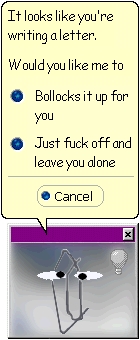
ErrorMsg08I am reminded here of the erstwhile Microsoft Office Assistant – that built-in help system to the Office ‘Desktop Productivity Suite’ (yeuch!) that at one point took the form of an animated cartoon paper-clip (humorously named ‘Clippy’) that would pop up at inopportune moments with ‘helpful’ advice.

This anthropomorphic little gimmick annoyed people to such an extent that it was eventually and unceremoniously killed off, to the cheers of all concerned.

Clippy was also – and not surprisingly – extensively parodied… one of my particular favourite examples being that appended here.

“What the blazes” – I hear you cry – “does this have to do with the photos on your blog?”

Bear with me and I will explain…

Modern digital cameras record – alongside the images themselves – a considerable amount of information pertaining thereto. This information – known as metadata – includes such items as the camera settings, the date and time that the pictures were taken and even, on some cameras, the associated GPS co-ordinates. Much of this data is stored alongside the images themselves in a format called the EXtended Image Format – or EXIF.

One item thus recorded is the orientation of each photograph. The camera has a sensor that tells it which way up it is, and when one rotates it through 90 degrees to get a ‘portrait’ shot rather than the standard ‘landscape’ variant the camera records this.

All well and good thus far. The problems start when the image is transferred to a computer for processing. I always check images on my PC before uploading them to this blog, so that I can adjust light and colour values and do any cropping necessary. Now – much Windows based image handling software completely ignores the EXIF data and, as a result, portrait oriented images are displayed sideways. I can rotate these images manually to get them the right way up, but the fact that I have done so is not recorded by any modification of the orientation data that accompanies the image.

What happens next depends once again on the software concerned. When I upload an image to a WordPress site – such as this blog – the EXIF data goes along with it and is stored – in some form – in the WordPress database. When a picture on the blog is viewed through a browser both the image and the metadata are passed to the viewer.

Windows browsers ignore the EXIF data and render the picture as I wish it to be seen – rotated manually to the correct orientation. IOS on the other hand – on all those iThings – determines from the EXIF orientation data that the picture was originally taken at a 90 degree angle and rotates it once more, making it once again come out sideways.

There appears to be no way of instructing any of the software concerned to modify this behaviour. What makes matters worse is that things are not consistent. As software versions change so also does the the default image handling behaviour. This latest problem appears to have arisen a couple of months ago from a change in the way that WordPress handles image uploads. I can tell this because images uploaded prior to this point still render as expected, but those taken subsequently do not.

The answer that I have adopted – you will not be surprised to hear – is to do the job myself. I use a basic image editor to orient the photo the way that I want it and I now use an EXIF editor to remove the orientation field completely to prevent further manipulation. This is – frankly –  all a total pain and should not be necessary.

As ever the problem really arises because users want one thing and the software and hardware vendors want another. Both are keen on clever gadgets that make life easier, but users would like these to adhere to standards so that everything plays nicely together, whereas the hardware and software manufacturers design their fancy must-have toys so that they are sufficiently different to those from other vendors that – once suckered in – the poor shopper has no choice but to go on spending his or her hard-earned cash on their goodies alone.

We are – it would seem – very well endowed with clever developers and designers who are capable of inventing quite unbelievably smart gizmos. Sadly we are also encumbered by lousy marketing and sales functionaries who can only figure out how to generate a revenue stream therefrom by being a total pain in the arse.

Sadly it was ever thus!


Tags: , ,

Image from Wikimedia CommonsThe hardest job kids face today is learning good manners without seeing any.

Fred Astaire

WARNING! – Grumpy old git whinge alert…

I am – of course – by no means the first upper-middle aged cosmopolite to cavil at the seemingly neoteric indifference to the desirability – nay, necessity – of good manners… and I am pretty dashed certain that I won’t be the last!

As the strapline above attests – however – I am not one of those who complains of a lack of politeness solely in the younger generation. Indeed I am in accord with the twinkle-toed hoofer in believing that if we want our progeny to behave appropriately we had jolly well better set them a decent example…

…which does seem to be beyond some of our number!

OK – I promise this brief post will not simply comprise an irritable catalog of perceived slights and causeless contumely. That really would take me into Mr Grumpy Pants territory (again)…

Instead, a slightly disconsolate appeal – made more in sadness than in anger – for at least some form of acknowledgement when I – or indeed anyone else – perform some little act of courtesy or politeness. How many times do we step aside for someone – hold a door ajar for someone – let someone out into traffic – smile a greeting at someone… only to be completely blanked in return! It is almost as though the person for whom this tiny act of kindness has been committed so resents the fact that it has been done that they can’t bring themselves even to look us in the face. Perhaps the subtext is that the man (or woman) who does something – anything – for his fellow is in some way demonstrated thereby to be weak… to be a ‘loser’!

Bizarre!

I have a distant memory of reading somewhere – many years ago – an article or book concerning the importance of human contact. Sadly I can no longer remember the title or provenance of this goodly tome, but the central tenet was – as I recall – that acknowledging others when we come into contact with them is the equivalent of giving – and getting – ‘strokes’, and that we need this affirmation – this contact – to build our self-esteem and to make us feel good about ourselves. If we acknowledge someone as we pass – even if only by a nod of the head – we give their ego a ‘stroke’… we effectively say “you are important enough in my world that I recognise your presence”.

Of course – if we do this and are blanked in return the opposite message is also heavily reinforced.

Now – it is one thing for our mere presence to go unacknowledged – quite another for any act of generosity – however minor – to be effectively thrown back in our faces.

Extremely unlikely as it may be, should you – dear reader – recognise in yourself even the possibility of being guilty of such behaviour – all I can say is – “get a grip!”.

Tags: ,

Image by Geni on WikipediaA recent and somewhat vexatious – though in truth fairly mild – infection at the root of one of my molars has caused me to enter into my much dreaded decennial engagement with the amalgam of dentists. This suitably apposite collective noun, incidentally, (see what I did there?) comes courtesy of a rather wonderful website called ‘All Sorts‘, whose splendid ‘mission statement’ reads thus:

“All Sorts is a collection of collective nouns that may or may not have found their way into the Oxford English Dictionary. If you think that a charismatic collective is far superior to a dullard ‘bunch’ or ‘flock’ then this is the place for you.”

I digress!

Now – I know that those of you who are of North American origin will have a totally different outlook to us Brits when it comes to oral maintenance. I know this because the Kickass Canada Girl is at pains to point out the fact. Frequently! To understand the loathing that my generation has of all things carnassial one must revisit a little post-war English dental history. To quote from the online ‘Dentist Forum’ – in response to an item in the tabloid press concerning the perceived neglect of dental hygiene in the UK:

“What he fails to mention is the over treatment by dentists to anyone who is now aged around 50 or 60 will have suffered in their younger years. Many of this age group had the drill, drill and more drilling treatment. It wasn’t unusual as a child to visit the dentist for a check up in the 1960s and be told “that’s 10 fillings you need”. If many of this age group had only visited a dentist occasionally in their childhood, perhaps only when in pain, they would have had less unnecessary treatment and their teeth might be in better shape now.”

I was one such child. My memories of those two decades are of almost constant toothache – subsequent to each visit to the dentist. By the time the pain had subsided it was time for another checkup. What with the endless fillings (not in truth helped by the lack of fluoridation in drinking water in England at that point, nor by the sweet tooth that I inherited from my mother!) and the impacted wisdom teeth, I had a pretty rough time of it.

To cap it all I had a gap between my two front teeth. It was not a massive gap and nor was it unsightly. In truth was rather fond of it. The dentist – however – persuaded my parents that it should be fixed and I was reluctantly forced to wear a hideous and uncomfortable brace. I hated the thing so much that I avoided wearing it whenever I could get away with it. Eventually the dentist started to smell a rat – suspicious of the lack of progress. Finally my brother resolved the issue inadvertently on the cricket green by breaking one of my front teeth with a particularly vicious short-pitched delivery. The resulting cap removed the gap once and for all.


Dentistry has changed – of course – out of all recognition. Such barbarism as we knew in the 60s is a thing of the distant past. My practice now even calls me up the day following treatment to check that there has been no resultant discomfort. The surgery has more technology than NASA and can engineer a perfect set of teeth with laser like precision whilst rotating 3D animations of my molars on a large flat screen for my education and edification.

I was fitted – the other day – with a temporary crown; the which involves quite a lengthy procedure. There was at no stage – either during the treatment or at any point thereafter – any pain at all (unless one counts the cost of the procedure – which is eye-watering in much the same way as is a boot to the testicles!).

There remains but one complaint. The drill! It is not that it causes any discomfort these days – but the sound of the thing is exactly as I remember it from my youth. As a result my visits to the dentist these days cause me to suffer grim psychological flashbacks to my childhood some five decades ago.

Now – if they could only fix that…

Tags: , ,

Image from WikipediaNo sooner had I posted my previous epistle lamenting the cynical manipulation of statistics by those with political ambitions (whatever might be their particular persuasion) than the UK Chancellor of the Exchequer – George Osborne – obligingly provided a perfect illustration of this dark art.

The background is thus:

Just over a week ago Prime Minister Cameron embarrassed all concerned with an ill-judged, table-thumping tantrum when informed of a bill for £1.7 billion – for payment by December 3rd – that had been presented to the government by the European Union (EU). The fact that the figure was the product of the standard annual re-calculation of EU contributions based on GDP that applies to all EU member countries – in this case covering years back as far as 1995 – and that those involved had all known well in advance that it was coming up, apparently counted for little. Cameron chose to throw a hissy fit, claiming that the UK would not be paying what was owed – and certainly not by Dec 3rd!

The reasons for this unseemly display are – of course – entirely to do with the pressure that Cameron is under both from the anti-Europe UK Independence Party (currently busily engaged chipping away at tory support) and from the Eurosceptics within his own party.

On Friday Osborne met with European finance ministers to try to brow-beat them into making a deal. Such was indeed achieved – in that the EU ministers were persuaded to let the UK pay in two installments rather than one and – crucially as it turned out – with the initial tranche delayed until next year. This only marginally impressive concession gave Osborne the opening he had been looking for. Since the UK stands to get a rebate from the EU next year in any case, Osborne – by dint of a little devious ‘creative’ accounting – was able to claim that the amount to be paid had actually been halved! It has not – of course. He has simply subtracted from the total the rebate that we will be receiving anyway.

Osborne was immediately called out on this chicanery – not only by the opposition parties (as well as their own coalition partners!) in the UK, but also by the assembled EU finance ministers – leaving him looking decidedly foolish.

Now – it is no secret that I dislike Osborne intensely. He displays all of the very worst traits of the modern career politico and must surely bear a considerable measure of the the blame for the ongoing decline in trust of the political classes in the UK and the resulting disengagement from the political process.

I heard Osborne being interviewed on the BBC. As is usual with him:

  1. he simply refused to answer directly any question that was put to him by the interviewer, choosing instead to make tangential pre-prepared pronouncements instead. Apart from anything else this is downright insulting both to the interviewer and to the listening public.
  2. he wasted no opportunity – as ever – to place the blame for all of the country’s woes on policies that the previous administration enacted more than half a decade ago, regardless of the relevance to the topic at hand. Osborne appears to believe that the making of political arguments is akin to advertising soap powder or suchlike –  and that the simple and endless repetition of crude mantras will result in the gullible consumer eventually accepting the message as gospel.
  3. he constantly talks down to others in a condescending and patrician manner – the implication being that we are all insignificant nothings who should be jolly grateful to have such and intelligent and noble figure to whom we can look up.

The worst thing from my perspective is that Osborne is an old boy of the School. The notion that he might have picked up any of his Machiavellian trickery from his schooling does not bear thinking about.

Tags: , ,

Image from Wikimedia Commons This week’s depressing mid-term poll results from the US of A – as a result of which the Republicans have been (distressingly) able to declare possession of a mandate that all the evidence suggests the American people had no real wish to hand to them – reminds me that it is but a matter of months before we in the UK will also be subjected to an interminable period of electioneering by our own oleaginous political pretenders.

We face the prospect yet again of having to pick the bones out of the endless reams of misinformation, half truths and evasions that are the stock in trade of the office-seeking hustler. Each of the political parties has – of course – its own agenda and its own target demographic – and can inevitably be expected to distort the same basic facts in an effort to make its case. As the saying goes there are – “lies, damned lies and even bigger damned lies“… or something to that effect.

The rise both of the nationalist parties in Scotland and Wales and of the newer groupings of the extreme right (the extreme left being no-where to be seen these days!) has predictably thrown all into a state of panic and confusion. The battleground will – as ever – comprise the usual fertile conflation of the economy and the size of the State – the two being inextricably bound together, particular in times of austerity.

All of those even slightly to the right of centre will once again bang the drum for further swinging cutbacks to the welfare state – and their half (or even less) truths will as usual play upon the basest emotions of the masses… anger over benefit cheats, scroungers and feckless wastrels – and fears about the over-running of this fair land by hoards of illegal asylum seekers, eager to sup deep at the well of our state largesse.

In search of some balance I found this most useful article on the BBC’s website:

The truth about welfare spending: Facts or propaganda?

…by Brian Milligan, the BBC ‘s personal finance correspondent.

The Treasury is apparently sending to all 24 million UK taxpayers a document purporting to show the breakdown of the government’s tax spend – with particular emphasis on the welfare spend. The gist of Mr Milligan’s article is that the easy-to-digest pie charts that are clearly intended to strike a chord with disgruntled tax payers are in fact highly misleading. As ever with statistics it all depends on how the counting is done and on which criteria are used to categorise the outcome. By tweaking the methodology it is possible to demonstrate that the areas of welfare spending that might be the subject of cutbacks could comprise anything from 14% to 56% of public spending. Naturally the figures chosen – highly selectively – by those from each political camp will ‘prove’ exactly what those concerned most desire.

I have myself printed out a copy of the article to keep to hand throughout the campaign, as a prophylactic against the seductive siren voices of our would-be masters.

Tags: , ,

Image from Wikimedia CommonsEroding solidarity paradoxically makes a society more susceptible to the construction of substitute collectives and fascisms of all kinds.

Elfriede Jelinek

I am sure that I am not alone on this side of the pond in feeling the deepest sympathy for the family and friends of the member of the Canadian armed forces who was murdered whilst on duty in Ottowa on Wednesday last. Many of us in the UK would doubtless also like to take this opportunity to express our solidarity with our Canadian cousins.

On a number of occasions during the coverage from Ottowa on Wednesday Canadian commentators described the capital as a ‘sleepy’ city in a ‘sleepy’ country – the inference being that such sudden and brutal exposure to international terrorism had come as a rude shock.

The Kickass Canada Girl was in London on July 7th 2005 and was trying to get to the High Court when the bombs on the underground and the bus were detonated. She found herself with hundreds of thousands of others struggling to get out of the city with all public transport – as well as the mobile phone networks – having been closed down. One of her first observations to me on finally reaching home was how impressed she had been by the calm composure of all of those in whose company she had found herself. This was borne out the following day when the great majority of London commuters simply got back onto the underground and carried on as before. I had to point out that London does have an extensive history of such episodes – a good number having occurred in my life time.

Let me be blunt about this and re-state a truism. Terrorism does not work! The intent – to strike such fear into a civilian population that it will pressure its political leaders to follow a particular course of action – has been demonstrated time and time again throughout history to be a hopeless one. I hardly need detail here the tragic history of groups, sects and organisations that have – even over the last hundred years – failed to achieve their aims whilst creating carnage in the name of some misguided belief.

In the case of London it is hard to believe that a small group of deluded fundamentalist youths ever imagined they might succeed where the the entire might of the Luftwaffe and thirty years of dedicated campaigning by the IRA had failed. It is – of course – not just in Britain that the habitual response to the efforts of tyrants and murderers is a defiant refusal to let such vile actions affect – to the slightest degree – the normal course of life.

I would be most surprised if the response in Canada were significantly different.


Tags: ,

ballot-box-32384_640“Experience hath shewn, that even under the best forms of government those entrusted with power have, in time, and by slow operations, perverted it into tyranny.”

Thomas Jefferson

The final UK party conference season of the current parliamentary term draws creakily to close with the Liberal Democrats somewhat bravely gathered in Glasgow. The extravasate of the drab convocations that we have had thus far to endure has left us – frankly – numb with disbelief at the grim prospect of the eight months of campaigning that will now follow – in the run-up to the election next May.

The recent referendum on Scottish independence – along with the concomitant hullabaloo south of the border – has provided us with several excellent examples – in both positive and negative veins – of exactly what is wrong with the current political process.

My previous post on the referendum provided the positive illustration. It is quite clear that the splendid and unprecedented turnout on that occasion was the result – not of the frankly ludicrous posturings of the political parties – but of the Scots recognising that, for once, they actually had a say in something that mattered – a chance that they took with both hands.

The flipside side of the coin was – true to form – all too clearly demonstrated by the parties at Westminster. Having until this point remained nervously aloof from the proceedings they were finally galvanised by the single, erroneous poll a week or so before the event that suggested against all the odds that the ‘Yes’ campaign might actually triumph. The panicky political denizens of the capital at once scrambled to Euston station, took to Virgin Trains and headed north.

Once there the three main parties – Tories, New(ish) Labour and the Lib Dems – cobbled together a shaky agreement to dangle before the Scottish people an orange(ish) vegetable in the shape of an extension to the devolved power that they already had – in return for their remaining in the Union. Thus far all entirely predictable – the only surprise being that the consensus held just about for long enough for the poll to actually take place.

What happened next was – sadly – just as predictable. Scarcely had the Scots taken the bribe accepted this generous offer than Tory leader David Cameron scurried from the door of 10 Downing Street to issue this breathless edict. The government would – he insisted – most certainly honour its pledge to the Scots, but in the interests of fairness it would at the same time legislate for a devolution of powers to the poor downtrodden English – which latter must be effected concurrent with the former!

Was this mayhap a noble gesture – the righting of some ancient wrong – the far-sighted act of a great statesman?? Not a chance! It was a piece of shameless, shabby political maneuvering!!

Cameron knows all too well that this belated resolution of the West Lothian question would deprive Labour of its healthy rump of 41 Scottish MPs – and thus of any real chance of a future Commons majority. He further knows that Labour therefore must needs oppose the issue, and that when the Devo-Max process inevitably breaks down as a result he will be able to place the blame on them for the resultant broken promises to the Scots. This has nothing to do with the desires of the English for self-determination. It has everything to do with Cameron and Osborne’s desire to fatally wound the Labour party.

“So what” – I hear you say? “That’s just politics. If you can’t stand the heat…”

“Well” – say I – “that’s just not good enough!”

Had Cameron announced his intention before the referendum – instead of after the count – not only would there have most likely been no agreement to ‘save’ the Union at all, but also a fair chance that the Scots – seeing which way the wind was blowing – would have modified their thinking and given Cameron and Co the kicking at the poll that they so richly deserve!

And these are the men that want us to entrust them with our precious votes?!

Don’t get me wrong – I have no more truck with the shameless hucksters from any of the other parties either – that dare to perch so precariously on the shoulders of giants – those worthy statesmen of yore who so richly decorate the tapestry of the history of this land. It comes as no surprise that the impossibly patient inhabitants of these fair isles now clearly regard politicians as ranking even lower on the scale of pond-life than do tabloid journalists! How many now must be wishing fervently for a ‘None of the above‘ option on the ballot paper?


I would like to think that our forth-coming emigration to Canada will lead to our escaping into clearer air. Sadly – everything I read about Canadian politics suggests that things are just about as bad there as they are in the UK.

Sigh!

Tags: ,

« Older entries § Newer entries »