web analytics

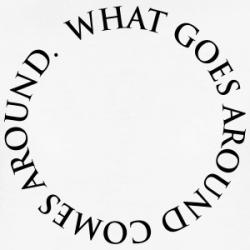
What goes around – 2

As promised in my last but one post – an anecdote with a strong element of nostalgia… for me at any rate.

Back in the day (promising start – though we need not concern ourselves as to exactly which day) I played in a variety of bands in and around London in the UK. My very first band – in which all concerned cut their teeth as musicians – stayed together for around eight years, which really is pretty good going first time out. Amongst our other achievements we became connected to a Young People’s theatre company for whom we were invited to write a musical… and then another… and another… By the end of the 70s we had played our part in the creation of three musicals – two of which had been taken to the Edinburgh Fringe.

By that time the band had reached the point at which it was clearly time to go our separate ways. As a farewell ‘tour’ we managed to land a week of gig bookings back in Edinburgh at the Fringe Club and a night Upstairs at Ronnie Scott’s in London. This was to be our swan-song.

Now, at that point there were two brothers in the band who both played keyboards, but who were – for reasons I do not now recall – unable to make the trip north. We decided to do that which bands in the UK were wont to do in such situations – we advertised in the Melody Maker for someone to fill in. The ad was answered by a keen young chap who will for the purposes of this piece go by the name ‘Dave’ (for that was his name!). He was young (about seventeen I think) and precociously talented. He was also a really nice guy.

He duly came to Edinburgh with us – played Ronnie Scott’s with us – was appropriately sad when everything came to an end and we resolved to stay in touch – the which for a while we duly did.

Now Dave had left school by this point and was looking for somewhere to work. As it happened I was a regular gawker (and occasional customer) at my local music shop in Surrey and one day I saw advertised there the position of keyboard salesman. I drew this to Dave’s attention; he applied and got the job.

The guitar salesman at the store was a chap called Gary. He was somewhat older than Dave and had ambitions in both production and to play in a band. He and Dave and a vocalist/bassist called Rod quickly started working together. They built themselves a small studio (a lot more difficult in those less technical days) and set about writing and recording. They attracted some interest and soon gained a publishing contract.

At about this time various other local bands started to avail themselves both of the studio and of Gary’s production talents. One of these outfits was a duo that went by the name ‘Go West’.

Now – this story is clearly going to make for quite a long post, so I think it best to split it here and to finish it off in what I promise will definitely be the very next post…

See you then…

Nostalgia…

Image by <a href="https://pixabay.com/users/radfotosonn-8242629/?utm_source=link-attribution&amp;utm_medium=referral&amp;utm_campaign=image&amp;utm_content=3204680">Radfotosonn</a> from <a href="https://pixabay.com/?utm_source=link-attribution&amp;utm_medium=referral&amp;utm_campaign=image&amp;utm_content=3204680">Pixabay</a>…as they say… ain’t what it used ter be!

Or… maybe, actually, it is!

Now – my last post offered you more nostalgia to come – and come it will, but events have conspired (as they so often do) to disrupt our good intentions and in this case to cause a slight nostalgia hiatus…

…though – actually – this substitute post also in some ways concerns that very same subject.

Enough with the cryptic references already!” – I hear you cry.

Fair enough. On with the show…

It seems but a few short weeks back that I was celebrating the fact that the Scots had just defeated the English at Twickenham in the first round of this year’s Six Nations Championship. This was a feat that they had not achieved for some thirty eight years and was thus cause for considerable jubilation.

My next post on the subject of Scottish rugby was a great deal less cheery and documented the sad loss at home by but a single point to Wales – and the further miserable loss, also at home, by a mere three points to the Irish. That post was titled ‘Same Old, Same Old‘ with good reason. In that post I also mentioned the postponed Scotland/France game – as a result of the French frankly playing fast and loose with the COVID lock-down guidelines.

On what should have been the final weekend of the tournament last weekend I could not raise the enthusiasm to discuss the Scots beating the Italians by a handsome margin (because that is what everybody else had done as well) and nor did I refer (drawing, in fact, a discreet veil over the matter) to the English losing to Ireland and thus ending the tournament in fifth place. The Welsh failed to beat the French in Paris and thus did not win a Grand Slam, but the outcome of the chamionship was left hanging: if France could beat the Scots in their rescheduled encounter (which took place today) by a certain amount they and not the Welsh would win the title.

OK – to cut a long story short – not only did the French fail to reach the necessary target but the Scots matched them throughout the game and – courtesy of a little unnecessary French generosity at the end – sneaked the win, 27 – 23. This was the first time that Scotland had beaten France in Paris since they famously did so in 1999 – the last year of the Five Nations before it became six.

Not only does this mean that Wales did eventually take the title (congrats!) but also the Scots have now within the last year broken their hoodoo on winning away games – and  have beaten the Welsh (last autumn), the English and the French on their respective home soils.

Now that is cause for celebration (particularly if you are  a Scot)!

Slàinte mhat!

What goes around – 1

It should perhaps be unsurprising in such times as these – that is, both when the winter is yet dragging its feet and noisily denying a platform to the incipient spring – and when the pernicious pandemic, still charging ahead at pretty near full throttle, keeps us cowering, heads well down, in our cardboard castles – that our thoughts turn to other and (in our memories at least) more gentle times.

Yes – it is for such ages that nostalgia was invented. This post (and quite possibly the next) will be devoted to the subject of just such wallowage (a word which appears in abundance on the InterWebNet but which may not be located within any dictionary as far as I can see).

At this point two years ago we were excitedly preparing for our last visit to the UK and to Europe (now, of course, sadly different things!). As that was to be our first trip back since moving to Canada in 2015 it is not surprising that revisiting old haunts and re-uniting with loved ones – both family and friends – featured prominently on the agenda.

Having done so within these postings on more than one occasion I am not about to recount yet again our doings on that trip but more to dwell upon the aftermath thereof… the echoes, should one prefer. I wrote at the time of the friends and family with who we had been re-united and I also waxed extremely lyrical concerning the long-lost contacts that were remade – particularly with those with whom I had at one point been fortunate enough to have created music or theatre.

Quite delightfully many of us who re-kindled associations on that trip are still in touch by one means or another – but mostly, it should be said, courtesy of the InterWebNet. Some keep in touch by email – some follow this blog (and on occasion respond thereto) and others have formed or joined the sort of online groups that may be used to share memories of people, places and events from our shared pasts.

Quite apart from the pleasures to be enjoyed by the recollection of the treasured memories that may thus be evoked this does give me – at least (though I suspect others also) – pause to consider just how rich were the experiences that we shared and the relationships that we formed. In my view we were – and still are – lucky, lucky people…

The next post will concern one of those odd little twists of fate that perhaps all lives throw up… (or perhaps not)!

On with the nostalgia…

First cut

We really must be heading into spring, because it is time already to give our lawns their first cut of the year.

This always seems to come as bit of a rude shock (to me, anyway) particularly if the weather is not being at all spring-like. Yes – I am a very fair-weather gardener. I know that there are many others (no doubt gardening betters) who treat the whole business in the same manner that some people do fitness… the tougher and more hideous the conditions the more they seem to relish it.

Let me at it!” they cry, as late winter storms sweep in. “I can’t wait to hit the wall!

Peculiar behaviour if you ask me (and I am well aware that you did not!)

Anyway – where was I?

Ah – yes… The thing is that each day during the week I am obliged to trot up the road to our community postbox. This, naturally, entails passing by the gardens of our neighbours and – whereas the English have a fondness for hiding their gardens away behind high walls – here in Canada they like everyone to be able to gaze upon their efforts. It is as a result quite clear who has done the deed (in the lawn mowing sense) and who has not. I can let the early adopters get away with it but there comes a point at which weight of numbers makes clear the democratic will. The verdict? Time to cut the mustard (and the grass)…

Anyway – ‘tis done.

Now, of course, other and tougher questions arise. Should I lime the lawns again (yes!)? Should I fertilise (also yes) and if so with what combination of chemicals? Should I start to bag my clippings or let it mulch the lawn (not sure)? Should I take on the moss (noooooo!) or learn to love it and live with it (nods head furiously)? Should I be focusing so much on the grass when everything else in the garden is also wide awake and demanding attention (whistles a jaunty tune and pretends not to have heard the question)?

Oh well – at least it helps me to stay fit(ish)…

Roll on the summer – say I!

Same old, same old

Same old, same old
(Informal)

“Used to say that a situation or someone’s behaviour remains the same, especially when it is boring or annoying:”

Cambridge Dictionary

I started to look back over some of the earliest of the posts to this online journal – to those composed in early 2012 – thinking to re-discover the very first occasion within these scribblings upon which I reluctantly drew attention to my ongoing and painful support for the Scottish rugby XV!

I recall bemoaning the fact that being a follower of these tartan-toting sportsmen involved endlessly repeated rounds of rose-tinted and entirely unreasonable optimism – followed rapidly by by dejection and misery when the Scots yet again failed to live up to the unwarranted expectation.

It is almost worse when they actually start to look as though they know what they are doing – to exhibit some flair for the game – to unearth at last at least one truly world-class talent… At that point they catch the eye of those commentators who would dearly love to see a challenge to the boring prospect of any of the other home nations yet again lifting the annual trophy – and would happily pay good money to watch the Scots rekindle the flame of 1990 (yes – it was that long ago that the Scots famously beat England at Murrayfield to win their last Grand Slam).

(In a small aside at this point I must make reference to an opportunity sadly lost! For the last years of my employ at my last school in the UK before ‘retiring’, the headship of the institution was in the capable hands of a man who – amongst his other obvious talents – had played rugby for England. As it happens the Calcutta Cup fixture in 1990 – in which both Scotland and England had the chance of taking the Grand Slam – was his last match in international colours for England. I always meant to tease him about it but never quite plucked up the courage so to do).

This melancholy musing naturally reflects Scotland’s performance thus far in this year’s Six Nations tournament. I wrote of the famous win against the odds at Twickenham but a few short weeks back but have since been silent on the matter within these pages. One need not search too hard to discover why. The Scots lost by a single point to the Welsh at Murrayfield – having at one stage been well in front before having a man sent off. The French game was then postponed because of positive COVID tests amongst the French squad. Finally – this very morning the Scots lost once again at Murrayfield… this time by a mere three points to the Irish. To be honest the Scots did not deserve to win today. Their line-out barely functioned and they gave away far too many needless penalties.

Where the Scots are concerned it is yet again a sad case of ‘Same old, same old’!

As I said at the top of this post – I started to look back to see when it was that I very first mentioned the painful predicament of supporting Scottish rugby…

…but then I lost the will to live!…

The life raft

“With COVID-19, we’ve made it to the life raft. Dry land is far away”

Marc Lipsitch

It has now been a year since the advent of the COVID-19 pandemic changed all of our lives utterly. Some – of course – have been far worse affected than others and our hearts go out to those who have lost loved ones or whose lives have been dramatically and negatively impacted in any way by the virus and the resultant disease.

I am sure that the gentle reader will have – as have I – been keeping abreast of the situation by following news stories, reading articles and watching documentaries… or perhaps you have had enough of it all and just want to keep your heads well down until things return to ‘normal’.

I watched an excellent Horizon documentary on the estimable BBC the other night which I thought summed up pretty well where we are, how we got here and how things are likely to unfold in the months ahead. I thought I would just take the opportunity to summarise the key points therein – as I saw them – the which you can choose to take or leave as you will.

The first thing to say is that there has clearly been a step change in the technology of creating and developing vaccines. We now have newer and more sophisticated means of developing and testing vaccines which have given us an advantage that we have not previously held. Not only should this give us renewed hope for an abatement of this pandemic but will arm us for other similar situations in the future. Given the huge amounts of work and brilliance that have gone into this work let us fervently hope that it is not undone by frankly ‘wacko’ conspiracy theorists persuading good folk not to welcome these developments.

The science has done well in many regards during the lock-down. We now understand many things about this virus that we did not before. It seems clear that the virus does not spread evenly, but that certain individuals infect a much greater number of others than might be expected. It would seem that this comes down to two criteria – the stage of the infection in the spreader (the which determines how virulent it is) and the particular circumstances in which that individual comes into contact with others.

The lesson to take from this is of course that the recommended precautions should be followed at all times. The chance of getting infected from any particular interaction may be lower than might be expected, but should the encounter be what has been described as a ‘super-spreading event’ then the odds will be much higher. No such chances should be taken.

Fears concerning mutations are valid, but it appears that more such occur when the virus remains in an infected individual for an extended period. Knowing this should enable – with the help of effective contact tracing – the rapid tracking down and eliminating of many new variants.

How will it all end? It seems to be the thinking that we could find ourselves in a position in which the Corona virus will need to be treated in the way that flu viruses are; that there will be a season in which routine jabs will protect us from infection. That – along with greatly improved treatments for those who do become infected – should at least enable us to evolve a ‘new normal’ that looks a fair bit more like the old one.

In short – continue to take care and stay safe!


Already strong

“Feminism isn’t about making women strong. Women are already strong. It’s about changing the way the world perceives that strength.”

G.D. Anderson

March the 8th is International Women’s Day!

The Kickass Canada Girl – though certainly by far the ‘kickass-iest’ that I have met – is certainly not the only lady to whom the epithet might be applied (with appropriate permission of course). As an irreflective member of another gender I would just like to say a heartfelt “Thank you” to The Girl and to all other women who by their indefatigable efforts help to make the world a better place.

I hope that you have a good and productive day.

Waiting to fly

“Creativity is the Blue Heron within us waiting to fly; through her imagination, all things become possible”

Nadia Janice Brown

We had an unexpected but most welcome visitor to our back garden the other day, the which we are pretty much 100% certain was a Blue Heron. Hello – Blue Heron!

Could be a male – could be a female. The main difference between them (according to the InterWebNet) is apparently one of size. You see our problem! It looked pretty big to us…

Anyway – he (or she) spent some hours sitting up in one of our fir trees. For the longest time he/she had his/her head tucked under one wing – presumably catching some well-deserved (not that we would know!) sleep – but that doesn’t make for such a good picture.

These are the photos that came out the best. Click on the images for the big – er – picture!…


Photo by Andy Dawson ReidPhoto by Andy Dawson ReidPhoto by Andy Dawson Reid

Reflector

A very dear friend here in Victoria gave me for Christmas a copy of Bob Woodward’s 2020 book on Donald Trump – ‘Rage‘. This friend is building an excellent reputation for giving me thoughtful and imaginative gifts – particularly in the form of books that should be read – and this is no exception.

Now – some readers might well demur.

Trump is gone – thank heavens!” – they may say. “Why would you not just consign all thoughts thereof to the dustbin of history?“.

The reason for not so doing, of course, is that one must always be on guard and must without fail be able to recognise the enemy. That Trump was elected in the first place is scary enough. That he might be so again – or that someone in his image could so do – is an ongoing, clear and present threat.

At one point in the book Woodward recalls an English professor at his college who advised him that – to be an effective biographer – the writer must find true ‘reflectors‘ of his subject – ie: those who know the subject intimately and can provide perceptive character assessments. Woodward toys with the notion of casting Jared Kushner (Trump’s son in law) in the role, but decides that he is too much in thrall to the man himself.

What changes his mind is advice that Kushner gives to unspecified others on how to understand Trump. He points them in the direction of four texts:

  • A piece on Trump by Pulizter Prize-winning columnist from the Wall Street Journal – Peggy Noonan. Noonan writes:

We are not talking about being colorfully, craftily unpredictable, as political masters like FDR and Reagan sometimes were, but something more unfortunate – an unhinged or not fully-hinged quality that feels like a screwball tragedy.

Noonan continues: “Crazy doesn’t last. Crazy doesn’t go the distance. Crazy is an unstable element that, when let loose in a stable environment, explodes.

  • Kushner’s second text is ‘Alice in Wonderland‘ – and specifically the Cheshire Cat! Kushner paraphrased the cat:

If you don’t know where you are going, any path will get you there.

  • The third text is Chris Whipple’s book – ‘The Gatekeepers: How the White House Chiefs of Staff Define Every Presidency‘. In a section on Trump added in 2018 Whipple wrote that:

Trump ‘clearly had no idea how to govern’ in his first year in office, yet was reluctant to follow the advice of his first two chiefs of staff – Reince Priebus and John Kelly“.

  • The final text is Scott Adam’s (the creator of the Dilbert comic strips) book – ‘Win bigly: Persuasion in a World Where Facts Don’t Matter’. Adams argues that:

Trump’s misstatements of fact are not regrettable errors or ethical lapses, but part of a technique called ‘intentional wrongness persuasion’Trump ‘can invent any reality’ for most voters on most issues and ‘all you will remember is that he provided his reasons, he didn’t apologise and his opponents called him a liar like they always do’.”

Kushner adds:

Controversy elevates message… A controversy over the economy – and how good it is – only helps Trump because it reminds voters that the economy is good. A hair-splitting fact-checking debate in the media about whether the numbers were technically better decades ago or in the 1950s is irrelevant“.

Remember that these are texts that Kushner – a fervent acolyte of the then-president – volunteered by way of trying to help others to understand Trump. Woodward concludes:

When combined, Kushner’s four texts painted President Trump as crazy, aimless, stubborn and manipulative. I could hardly believe that anyone would recommend these as ways to understand their father-in-law, much less the president they believed in and served“.

We would be wise – to quote Thomas Cranmer – to: “Read, mark, learn and inwardly digest…

Fragile

“If only these treasures were not so fragile as they are precious and beautiful.”

Johann Wolfgang von Goethe – The Sorrows of Young Werther

I watched the other day – on the splendid but disturbingly imperiled BBC – the latest in Alan Yentob’s arts strand – ‘Imagine’. The most timely subject of this episode was the delicate state of the arts in the UK (but by extension also throughout the western world) as a result of the COVID-19 pandemic.

The point was well made that the case for spending government monies to protect the arts at a time when the health service is all but overwhelmed and when old people are dying in care homes (as was certainly the case at the start of the pandemic) is extremely difficult to make. It is – of course – always difficult to mount any such convincing justification for the arts in times of crisis and disaster.

Except that – whereas Mazeroff’s ‘Hierarchy of Needs’ certainly depicts our physiological and safety needs as comprising the broad base of the pyramid, as one heads on upwards towards the top where love and belonging, esteem and self-actualisation are to be found, we once again rapidly discover (as a by-product of our unwanted incarceration through lock-down) that life without the arts, with all their magnificent variety and substance, loses a surprising measure of its meaning.

If that were not case enough for protection of our priceless and precious artistic assets then let us fall back on that ever reliable argument – economic benefit. In the UK alone the arts and culture sector contributes nearly £11 billion a year to the UK economy on a turnover of more than £21 billion per year – supporting in excess of 260,000 jobs. Even given that some £900 million of funding flows each year from central government into the arts and culture, the recuperation from the sector of £2.8 billion a year in tax revenue represents a very decent return.

The UK government has at least recognised the urgency of supporting the arts sector – the which was by and large the first to close in the COVID-19 lock-downs and will in all probability be the last to re-open – and has made £1.5 billion in funding available to keep companies and venues afloat.

All very reasonable as far as it goes – except that the arts is considerably more than just famous actors and musicians, well-renowned companies and grandiose venues. The majority of those who work in the arts and culture sector do so, in fact, as freelancers and as such are not covered by the government’s emergency funding arrangements. Anyone who has even tenuous connections with the arts world (as do I) will know of people whose livelihoods have all but disappeared overnight. If they are forced out of the arts for good a large chunk of the arts economy will disappear with them.

Please do spare a thought for such folk and do whatever you can to support them.